Dragonja
Also known as: Dragonja the Ploughman, Div Orač
Basic account
Istrian giant who ploughed the Mirna into being; his kind built the hill towns.
Account
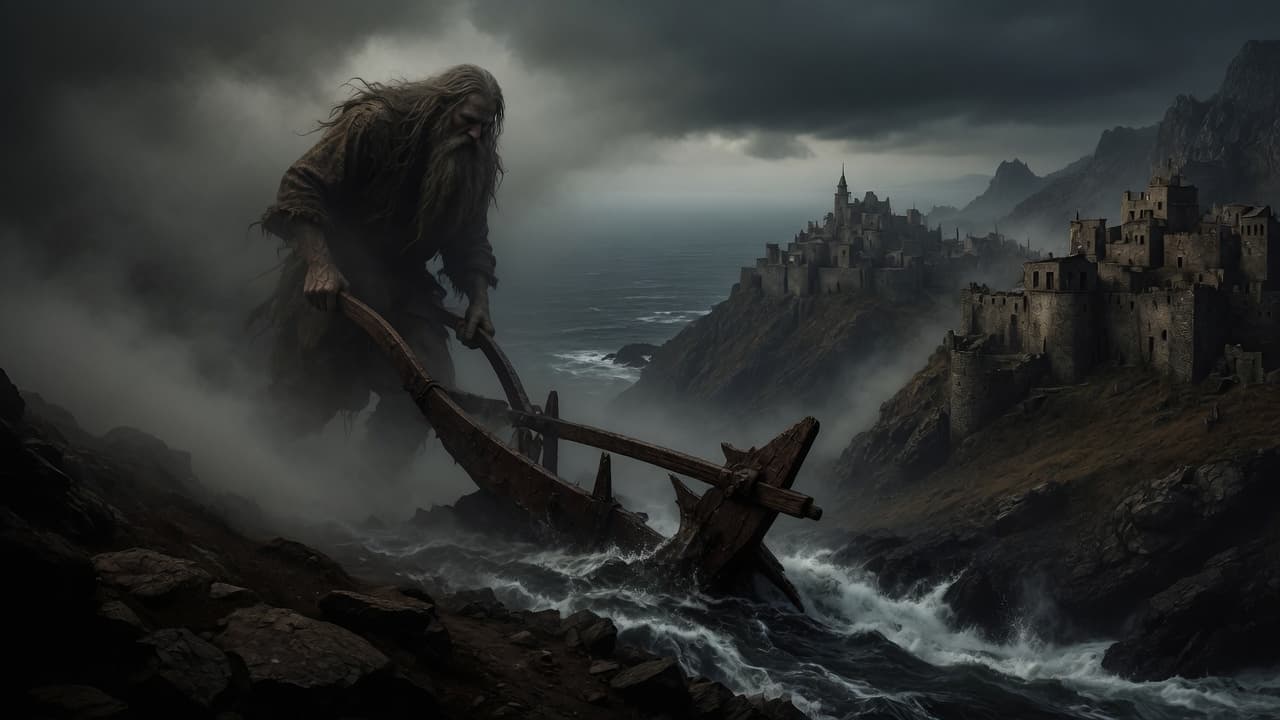
He dragged a plough from the mountains to the sea. Water followed the furrow, and he named it Mirna.
The story
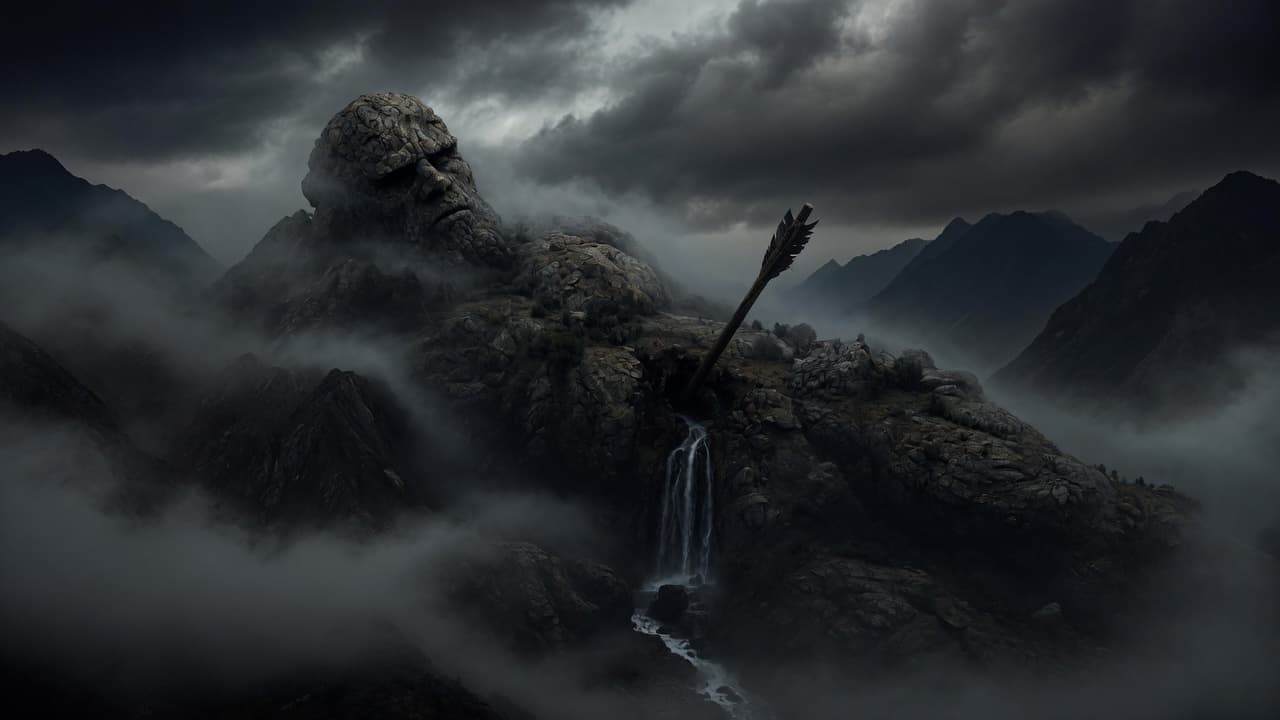
Before people settled Istria, the valley of the Mirna belonged to giants. The chief among them was Dragonja, called the Ploughman, because he cut the furrow from Ćićarija down to the coast and let the river in. The border river Dragonja still carries his name.
The giants built the hill towns: Motovun, Vrh, Sovinjak, Oprtalj, Završje, Roč and Grožnjan. They were so large that each worked his own hilltop and they passed tools and building stone to one another across the valleys between. When the towns were finished there was stone left over, and rather than waste it they built one more. That is Hum, which now advertises itself as the smallest town in the world.
After the work they rested at Kotli, where the water falls in steps and where people still walk today.
Dragonja's son Gorazd is said to be in the forests of the Istrian highlands still, watching them.
Set him beside Daidarabotchi in Japan. Both are giants who made a real, named, walkable landscape by working on it while they were alive, which is the opposite of Ymir, who had to die first.
Where it comes from
This is local place-legend from the Mirna valley in central Istria, tied to named ground rather than to any medieval text: the rivers Mirna and Dragonja, the hill towns above them, the water steps at Kotli.
Nineteenth-century collecting in Istria concentrated on song. The circle around the newspaper Naša sloga gathered oral material from 1879, printed as Hrvatske narodne pjesme što se pjevaju po Istri i Kvarnerskih otocih in 1880, and Jakov Volčić recorded songs, tales and proverbs. Prose legend was the poorer relation. Carlo De Franceschi (1809 to 1893), historian of Istria and secretary of the Istrian Diet from 1861 to 1876, is the name cited for giant traditions from the Motovun district.
Systematic prose collecting came in the 1950s, when the Institut za narodnu umjetnost in Zagreb, now the Institute of Ethnology and Folklore Research, worked across the peninsula. Maja Bošković-Stulli edited the result as Istarske narodne priče (Zagreb, 1959), the first volume of the series Narodno stvaralaštvo Istre, with her introduction and commentary.
The tradition now travels largely through local tourism, which has an interest in it.
Motifs
Shaped the land while living
The giant made the country by working it: dropping stones, digging channels, dragging a heel. Distinct from the giant whose corpse becomes the world, and distinct again from the giant who is the hill.
Also carried by: Daidarabotchi (Japanese), Kalev and Kalevipoeg (Estonian, Finnish, Karelian)
The giant as builder
Walls, causeways, dolmens and bridges attributed to giants: usually structures whose real makers had been forgotten.
Also carried by: Budj Bim Giants (Australian Aboriginal (Gunditjmara related landscape)), Gargantua (French), Jentilak (Basque), Mouros (Galician, Asturian, Portuguese), Paul Bunyan (American tall-tale), Quinametzin (Mesoamerican / Aztec), Tombe dei Giganti (Sardinian), Xelhua (Mesoamerican), Croatian Giants: The Lesser Traditions (Croatian)
The river came from a giant
A watercourse is explained as a giant's tear, blood, urine, furrow or dropped burden. The river is permanent, so the explanation has somewhere to live.
Also carried by: Klek (Croatian)
Attached to a real place
The tradition is anchored to a site you can still walk to: a dolmen, a cave, a hill fort, a named rock. The story travels with the ground rather than with the teller.
Also carried by: Baqbaq-Devi (Georgian), Bendigeidfran (Welsh), British Giants: The Lesser Traditions (British and Welsh), Daidarabotchi (Japanese), Gargantua (French), Kalev and Kalevipoeg (Estonian, Finnish, Karelian), Koljo (Finnish), Mapinguari (Amazonian, Brazilian), Milžinai (Lithuanian), Suur Tõll (Estonian), The Giants of Santa Elena (Manta, recorded by Spanish chroniclers), Tombe dei Giganti (Sardinian), Tröll (Icelandic), Croatian Giants: The Lesser Traditions (Croatian), Klek (Croatian), Nemri (Croatian)
What is disputed
The most famous Istrian giant, Veli Jože, is not folk tradition. He comes from Vladimir Nazor's novel of 1908, which draws on Istrian material but is an authored work written with a national awakening in mind.
He is frequently presented as ancient. He is not.
Sources
- Maja Bošković-Stulli, Istarske narodne priče
- Carlo De Franceschi, who recorded giant traditions around Motovun