Klek
Also known as: Veliki Klek, uspavani div, the sleeping giant
Basic account
Croatian giant petrified above Ogulin: the river Dobra runs out of his wound.
Account
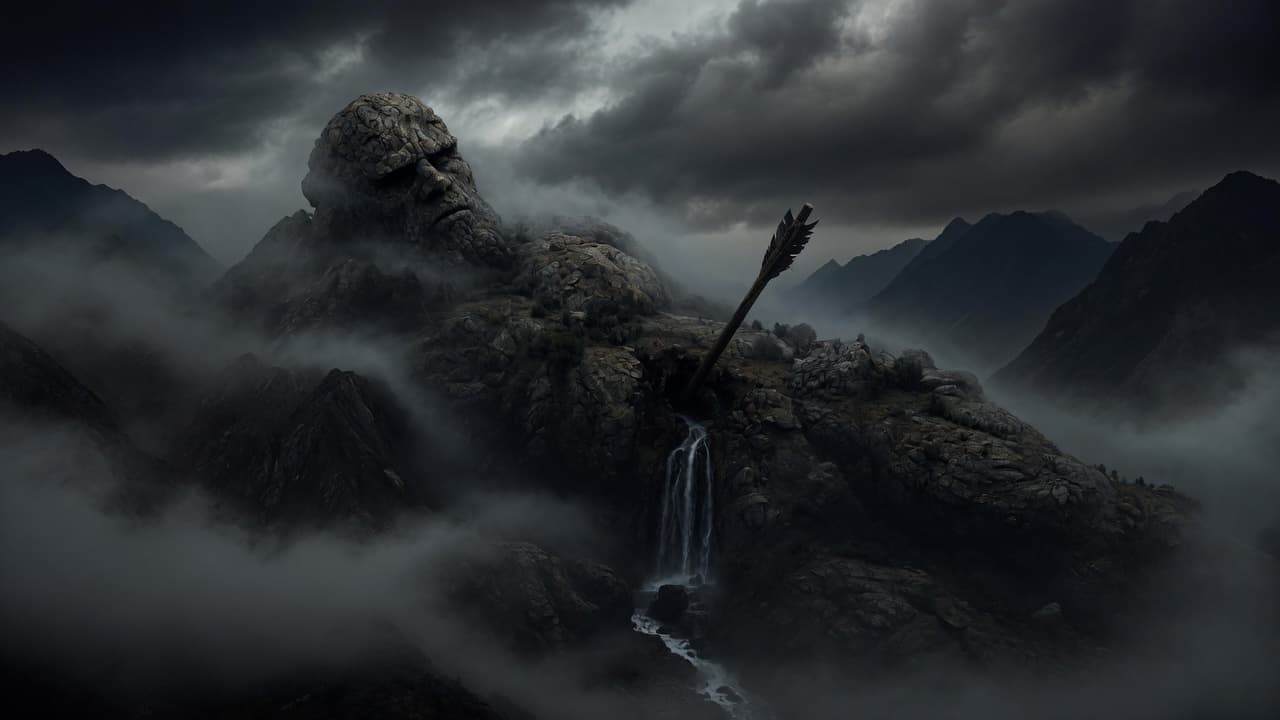
Seen from Ogulin, the mountain is a sleeping man. The peak is his head.
The two crags below are his legs.
The story
Klek, Orjen and Snježnik are giants who were turned to stone. Klek is the one people can still read at a glance: from the Ogulin side the ridge lies down as a sleeping giant, the summit at 1181 metres is the head, and the Klečice crags coming up out of the treeline are the legs.
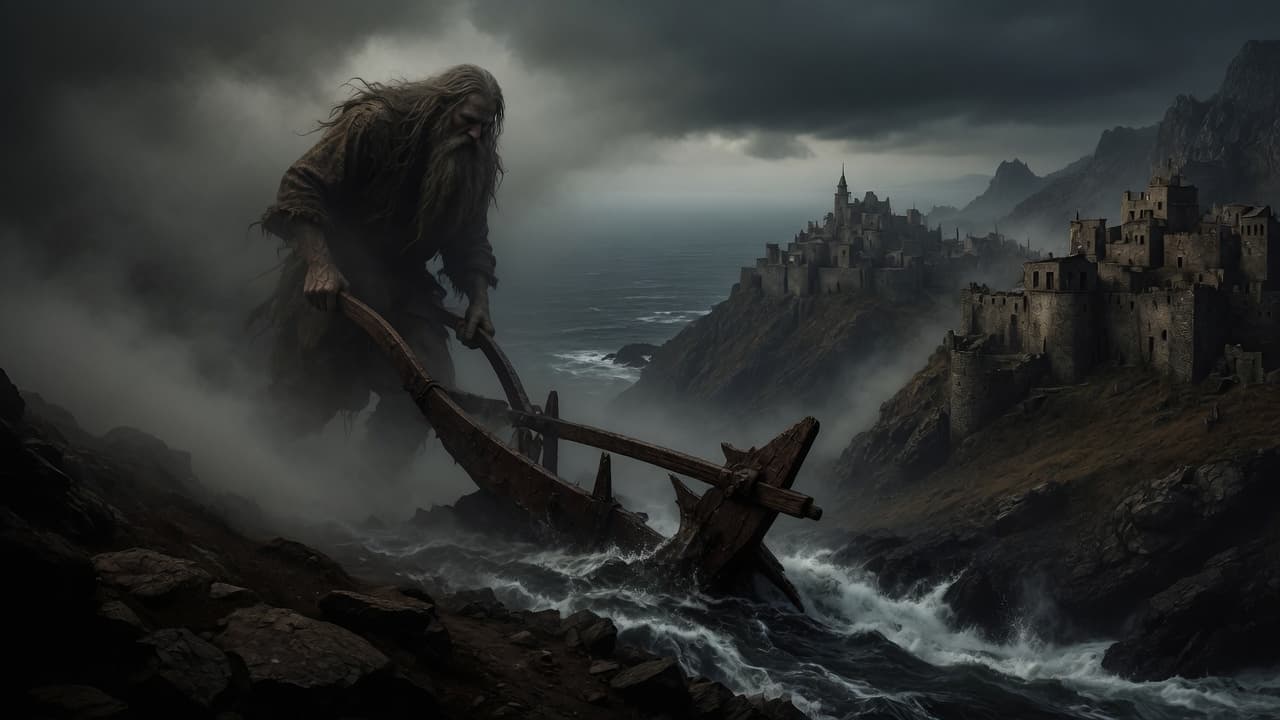
He was running when it happened. Perun struck him with an arrow in the right vein as he fled, and the people named that vein the river Dobra, also called Đula.
That is worth sitting with. The river is not named after the wound. The river is the wound. It is the same logic that turns Ymir's blood into the sea, worked at the scale of one valley.
Klek carries a second tradition on top of the first. Witches gather there, and the lightning around the mountain is their assembly. The two stories share the mountain without much interfering with each other.
Where it comes from
The tradition is local and topographic, fixed to one ridge in the Velika Kapela massif above Ogulin: Veliki Klek at 1181 metres, with Klečica at 1062.
The earliest written notice belongs to the witches rather than to the giant. Johann Weichard von Valvasor, author of Die Ehre dess Hertzogthums Crain (1689), is credited with recording the Klek assembly in the seventeenth century.
The petrifaction story reaches print through twentieth-century Croatian collecting. Stjepan Banović's Vjerovanja (Zaostrog u Dalmaciji) appeared in 1918. Nikola Sučić's Hrvatska narodna mitologija was published in Zagreb in 1943 and reprinted in 2013 with an afterword by Tomislav Pletenac that presents it as a monument to its own period rather than as method. Maja Bošković-Stulli (1922 to 2012), of the Institute of Ethnology and Folklore Research in Zagreb, supplies the critical baseline for Croatian oral legend.
Later transmission ran through mountaineering writing, Klek being called the cradle of Croatian mountaineering, and through Ogulin's modern fairy-tale tourism.
Motifs
Turned to stone
A giant becomes a rock, hill or island. The landscape is offered as the surviving evidence, which is what makes the story durable.
Also carried by: Budj Bim Giants (Australian Aboriginal (Gunditjmara related landscape)), Cormoran (Celtic / Cornish), Tröll (Icelandic), Croatian Giants: The Lesser Traditions (Croatian)
The river came from a giant
A watercourse is explained as a giant's tear, blood, urine, furrow or dropped burden. The river is permanent, so the explanation has somewhere to live.
Also carried by: Dragonja (Croatian)
Attached to a real place
The tradition is anchored to a site you can still walk to: a dolmen, a cave, a hill fort, a named rock. The story travels with the ground rather than with the teller.
Also carried by: Baqbaq-Devi (Georgian), Bendigeidfran (Welsh), British Giants: The Lesser Traditions (British and Welsh), Daidarabotchi (Japanese), Gargantua (French), Kalev and Kalevipoeg (Estonian, Finnish, Karelian), Koljo (Finnish), Mapinguari (Amazonian, Brazilian), Milžinai (Lithuanian), Suur Tõll (Estonian), The Giants of Santa Elena (Manta, recorded by Spanish chroniclers), Tombe dei Giganti (Sardinian), Tröll (Icelandic), Croatian Giants: The Lesser Traditions (Croatian), Dragonja (Croatian), Nemri (Croatian)
What is disputed
Perun is one of the few Slavic deities securely attested rather than reconstructed, which gives this tradition a firmer footing than most Croatian material claiming pre-Christian origin. Much of what circulates online as Croatian or Slavic mythology, including elaborate creation stories and full pantheon genealogies, is nineteenth or twentieth century reconstruction or modern invention.
This is not that. But the surrounding material should be treated with care.
Sources
- Maja Bošković-Stulli
- Nikola Sučić, Hrvatska narodna mitologija, with the caveat that its scholarly standing should be checked
- Stjepan Banović, Vjerovanja (Zaostrog u Dalmaciji), 1918