Evidence & rumor
Bones & Shadows
Claims, hoaxes, and modern military legends live here under clear labels. Mystery is welcome; misrepresentation is not. Verified hoaxes are marked as such. Unverified stories stay unverified. Where a period photograph exists under a clear licence, it is shown; elsewhere you see catalogue art or mist, never a generated fake of a site.
Related entry art · Catalogue art for Si-Te-Cah (illustration, not a photograph of the claim)
Archaeological contextUnverifiedSi-Te-Cah Cave Remains
1912–1924 · Nevada, USA
Lovelock Cave (Nevada) yielded remains and artifacts linked in Paiute tradition to red-haired giants.
Excavations in the early twentieth century recovered basketry, duck decoys, and human remains from Lovelock Cave. Paiute oral history speaks of the Si-Te-Cah: red-haired cannibal giants driven into the cave and smoked out. Popular accounts inflate stature claims far beyond what osteological study supports. The cultural tradition is real; the giant-sized skeleton narrative remains unverified and often distorted in secondary retellings.
Sources: Paiute oral tradition; Lovelock Cave excavations
Related giant entry →Free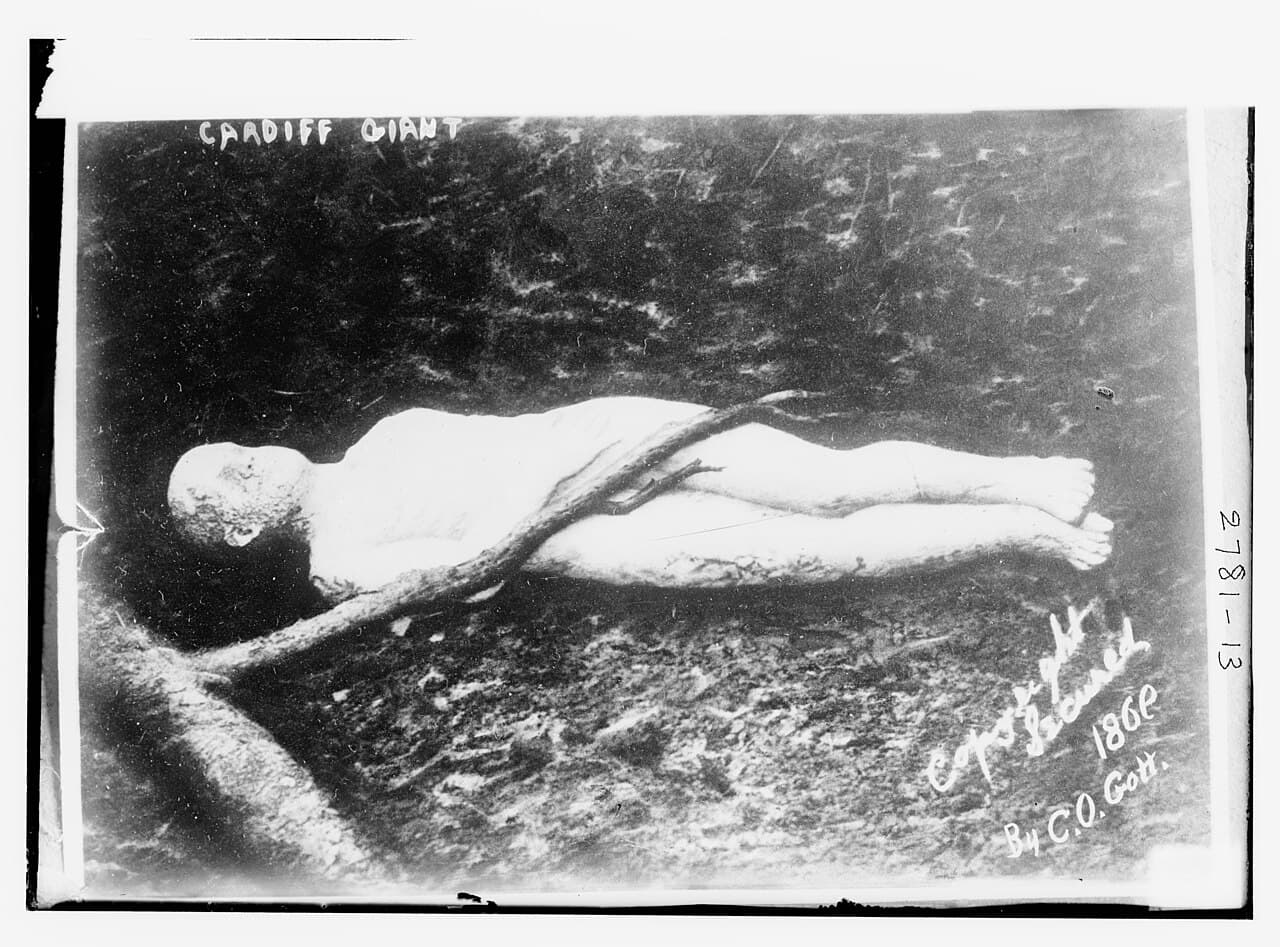
Library of Congress (LCCN 2014693762), public domain via Wikimedia Commons
Hoax / fraudStatus knownThe Cardiff Giant
1869 · Cardiff, New York
A carved gypsum figure buried and 'discovered' in 1869: one of America's most famous archaeological frauds.
George Hull commissioned a ten-foot gypsum figure, aged it with acids, buried it on a farm near Cardiff, New York, and arranged its 'discovery.' Crowds paid to see the petrified giant. P.T. Barnum later made a copy when denied purchase of the original. Hull confessed; the figure survives in museum collections as a monument to credulity rather than antiquity.
Sources: Contemporary newspapers; Farmers' Museum, Cooperstown
Chain of custody
In October 1869 men digging a well on a farm at Cardiff, New York, unearthed the petrified body of a giant man over ten feet tall.
Printed matter dating from within weeks of the digging records an excavation on a farm at Cardiff in October 1869, and the men of science quoted in it describe the object taken out of the ground as worked gypsum rather than a petrified body.
Related entry art · Catalogue art for Giant of Kandahar (illustration, not a photograph of the claim)
Modern legendUnverifiedGiant of Kandahar Reports
c. 2002 · Kandahar region, Afghanistan
Circulating oral accounts of a red-haired giant engaged by special forces near Kandahar. No official corroboration.
Reports claim… that coalition special operations personnel encountered a towering red-haired figure in the mountains near Kandahar in the early 2000s. According to the circulating account, the being carried a spear, wore rudimentary armor, and was killed after an engagement. No official records corroborate the story. The account spread through podcasts, forums, and second-hand military storytelling. Treat as unverified oral legend, not documented history.
Sources: Unverified oral accounts; Secondary media retellings
Related giant entry →
Related entry art · Catalogue art for Giant of Kunar (illustration, not a photograph of the claim)
Modern legendUnverifiedGiant of Kunar Reports
c. 2000s · Kunar Province, Afghanistan
Similar modern military legend from eastern Afghanistan. Unverified; presented here only as circulating folklore.
According to the circulating account, personnel in Kunar Province reported a massive figure observed or engaged in remote terrain. Reports claim… extreme stature and unusual physical traits. No official records corroborate these accounts. Grouped with other twenty-first-century giant legends that migrate through online communities and veteran storytelling networks.
Sources: Unverified oral accounts
Related giant entry →
Related entry art · Catalogue art for Nephilim (illustration, not a photograph of the claim)
Unverified claimUnverifiedNephilim Skeleton Claims
Various (claimed)
Recurring internet and print claims of giant biblical skeletons: frequently photo-manipulated or unsubstantiated.
From nineteenth-century newspaper wonders to modern viral images, claims of Nephilim bones surface repeatedly. Many photographs have been demonstrated as composites or museum props. No peer-reviewed osteological series establishes a population of multi-meter humans corresponding to these stories. The biblical and Second Temple literary tradition is ancient and significant; physical 'giant skeleton' claims remain unverified.
Sources: Biblical tradition; Debunked viral images
Related giant entry →Free
Related entry art · Catalogue art for The Patagonian Giants (illustration, not a photograph of the claim)
Unverified claimUnverifiedPatagonian Giants of Early Exploration
16th–18th c. · Patagonia
European explorers described towering indigenous people of Patagonia: later understood as exaggeration and cultural misperception.
Magellan's chroniclers and later voyagers wrote of men so tall Europeans reached only to their waists. Actual Tehuelche stature was often above European averages of the era, but not the legendary heights recorded. The 'Patagonian giant' entered European popular geography as fact for centuries before being scaled down by better ethnography.
Sources: Pigafetta and later voyage accounts; Modern anthropology
Related giant entry →- Hoax / fraudUnverified
Southwestern 'Giant' Burial Claims
American Southwest
Sensational claims of giant burials in the American Southwest, often recycled without primary excavation records.
Nineteenth- and early twentieth-century newspapers occasionally reported giant skeletons from cliff dwellings and mounds. Most lack museum catalogue numbers, measured osteology, or verifiable provenience. Some are known fabrications; others are garbled accounts of ordinary remains. Modern archaeology of Ancestral Puebloan sites does not support a giant population.
Sources: Period newspapers; Southwestern archaeology
Chain of custody
Giant human skeletons, seven feet and taller, were dug out of cliff dwellings, caves and burial sites across the American Southwest, and the Smithsonian Institution and other authorities carried them off and buried the evidence to protect the accepted account of human history.
Where the documents could be reached this session, the digging was reported in public and the remains described in them are of ordinary size.
Related entry art · Catalogue art for Og of Bashan (illustration, not a photograph of the claim)
Archaeological contextUnverifiedOg's Iron Bed (Deuteronomy)
Bashan / Rabbah (tradition)
Biblical text describes Og of Bashan's enormous iron bed: literary/mythic scale, not excavated furniture.
Deuteronomy records Og's bedstead of iron, nine cubits by four. The passage functions within ancient Near Eastern royal hyperbole and tradition about the last of the Rephaim. No archaeological bed matching the description has been recovered; the text remains a literary witness to ancient giant tradition rather than a measured artifact.
Sources: Deuteronomy 3:11
Related giant entry →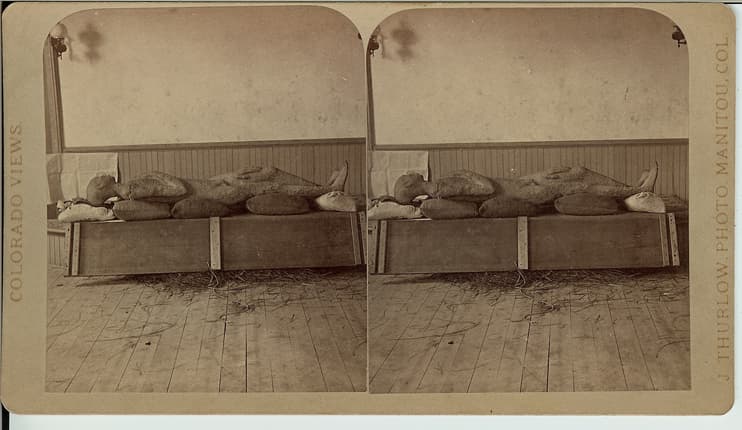
Period stereoview, public domain via Wikimedia Commons (Solid Muldoon Stereoview)
Hoax / fraudStatus knownThe Solid Muldoon
1877 · Beulah, Colorado, USA
A second Hull-linked petrified man, 'found' in Colorado in 1877 and later admitted as a fraud.
In 1877 a stone figure marketed as a petrified giant was exhibited after its discovery near Beulah, Colorado. Contemporary reporting connected it to the same circle of makers and promoters as the Cardiff Giant. The figure was broken up after the fraud became public. It is a known nineteenth-century American archaeological deception, not an open osteological puzzle.
Sources: Contemporary Colorado and national newspaper coverage, 1877; Secondary histories of the Cardiff Giant network (Hull and successors)
- Hoax / fraudStatus known
Barnum's Cardiff Giant replica
1869-1870 · New York, USA
P. T. Barnum exhibited a copy of the Cardiff Giant when he could not buy the original, and sued when rivals called his figure fake.
After the original Cardiff figure drew crowds, Barnum commissioned a plaster or similar replica and showed it as the petrified giant. Court and press coverage of the quarrel between the original exhibitors and Barnum is part of the public record of the hoax. The replica is evidence of how quickly the fraud became a commercial product, not of a second discovery.
Sources: Contemporary New York press on the Cardiff exhibitions; Standard histories of the Cardiff Giant (e.g. Tribble)
- Unverified claimUnverified
Castelnau 'giant' bones
1890s · Castelnau-le-Lez, France
Late nineteenth-century French reports of unusually large human bones from Castelnau-le-Lez, never established as a giant population.
In the 1890s Georges Vacher de Lapouge and others discussed large bone fragments from Castelnau-le-Lez in southern France and speculated about stature far above modern averages. The finds entered giant-lore literature as proof of a race of giants. They have not been accepted in mainstream osteology as evidence of a giant human population; the measurements, context and identification remain disputed or poorly documented by modern standards. Filed here as a historical claim, not as verified paleoanthropology.
Sources: Georges Vacher de Lapouge, period notes on Castelnau finds (1890s); Later secondary summaries in giant-lore literature
Related entry art · Catalogue art for Si-Te-Cah (illustration, not a photograph of the claim)
Archaeological contextStatus knownLovelock Cave duck decoys
1912-1924 · Nevada, USA
Real woven duck decoys and other artifacts from Lovelock Cave, often misused as props for giant narratives.
Among the objects recovered from Lovelock Cave are sophisticated tule duck decoys and a large assemblage of basketry and perishable goods. These are genuine archaeological finds and are among the best-known perishable artifacts of the Great Basin. Popular giant retellings sometimes stack them next to red-hair and stature claims as if they proved a giant culture. They do not. The decoys document skilled indigenous technology; they do not measure the Si-Te-Cah.
Sources: Lovelock Cave excavation reports (Loud and Harrington); Great Basin perishable-artifact literature
Related giant entry →FreeRelated entry art · Catalogue art for The Patagonian Giants (illustration, not a photograph of the claim)
Unverified claimUnverifiedPigafetta on the Patagonians
1520s · Patagonia
Antonio Pigafetta's account of tall people met on Magellan's voyage, the seed of three centuries of European giant talk.
Pigafetta described a meeting near what is now southern Argentina with people much taller than the crew. Later European writers inflated the height to twelve feet and beyond. Eighteenth-century measurements of Tehuelche and related peoples found them tall relative to contemporary Europeans but not mythical. The primary voyage report is a real text; the giant tradition that grew from it is a European literary and press phenomenon layered on a real stature difference.
Sources: Antonio Pigafetta, voyage account of the Magellan expedition; Later voyage measurements (Bougainville, Byron account)
Related giant entry →
Related entry art · Catalogue art for Goliath of Gath (illustration, not a photograph of the claim)
Archaeological contextStatus knownGoliath's height in the manuscripts
textual · Hebrew Bible manuscript tradition
Hebrew and Greek witnesses disagree on Goliath's height: six cubits and a span versus four cubits and a span.
The Masoretic text of 1 Samuel 17 gives Goliath six cubits and a span. The Septuagint, the Dead Sea Scrolls fragment 4QSam-a and Josephus give four cubits and a span. Both figures are textually real; which is earlier is argued among specialists. The point for this archive is that 'nine feet nine' is one manuscript tradition, not a measured skeleton, and that a second tradition places him nearer two metres. See the Goliath entry for the fuller text-critical note.
Sources: 1 Samuel 17 Masoretic text; Septuagint 1 Samuel 17; 4QSam-a; Josephus
Related giant entry →FreeRelated entry art · Catalogue art for Og of Bashan (illustration, not a photograph of the claim)
Unverified claimUnverifiedOg's iron bed as a measure
biblical text · Rabbah of the Ammonites (textual)
Deuteronomy 3:11 gives nine by four cubits for an iron object at Rabbah, not a height for Og's body.
The verse that made Og famous measures a bed or similar object, not the king. Ancient versions read a bed (Greek kline, Latin lectus). Some modern notes prefer a basalt sarcophagus. Either way, the Hebrew text does not state Og's stature. Later rabbinic stories enlarge him far beyond the bed. The finding exists so readers who meet 'Og was thirteen feet tall' online can see what the verse actually supplies.
Sources: Deuteronomy 3:11; Greek, Latin and Aramaic versions of the verse
Related giant entry →- Unverified claimUnverified
American newspaper giant skeletons
c. 1850-1920 · United States (various)
Recurring nineteenth-century US press stories of giant skeletons from mounds and caves, usually without museum numbers or remeasured bones.
Between the mid-nineteenth century and the early twentieth, American newspapers regularly printed brief items about giant human skeletons unearthed in mounds, mines or caves. Many lack excavator names, museum accession numbers or follow-up. Some are known fabrications; others are garbled reports of ordinary burials. Modern archaeology of the same regions does not support a giant population. This finding covers the genre rather than one named dig, so readers recognise the pattern when they meet a recycled clipping.
Sources: Nineteenth-century US newspaper digitizations (Library of Congress and others); Modern archaeological summaries of mound and cliff-dwelling sites
- Hoax / fraudStatus known
Composite 'mermaid' and giant sideshow types
nineteenth century · Touring exhibitions (US and Britain)
Nineteenth-century sideshow composites (including so-called mermaids) show the same exhibition economy that sold petrified giants.
The famous Feejee Mermaid and related composites were sewn or assembled animals sold as wonders. They sit beside petrified-man exhibits in the same Gilded Age circuit of paid curiosity. They are not giant osteology, but they document how display culture rewarded striking bodies, real or manufactured. Useful context when a 'petrified giant' story turns out to be a touring attraction.
Sources: Histories of American sideshow and Barnum exhibitions; Museum documentation of surviving composite specimens
Related entry art · Catalogue art for Quinametzin (illustration, not a photograph of the claim)
Unverified claimUnverifiedTeotihuacan and Mexican 'giant' burial rumors
Central Mexico
Recurring online claims of giant skeletons under Mexican pyramids, without published osteological series to match the viral heights.
Social media and older press occasionally claim giant human skeletons from Teotihuacan or other central Mexican sites. Published archaeology of Teotihuacan documents a major urban culture and ordinary human remains; it does not publish a verified population of multi-metre giants. Until a claim carries a site report, catalogue number and measured series, it belongs here as rumor adjacent to real sites, not as a finding of giant osteology.
Sources: Published Teotihuacan excavation literature (general); Absence of peer-reviewed series matching viral stature claims
Related giant entry →