Ravana
Also known as: Dashanana, Lankesh
Basic account
Ten-headed king of Lanka: scholar, devotee, abductor of Sita.
Account
Ravana, ten-headed king of Lanka, is the antagonist of the Ramayana and one of the most accomplished beings in it: a scholar of the Vedas, a master of the veena, and a devotee of Shiva whose devotion is exactly what makes him dangerous.
The story
Ravana is not a monster who happens to be clever. He is a rakshasa king who earned everything he has.
Through immense austerities he wins a boon from Brahma: he cannot be killed by gods, demons, rakshasas, gandharvas or any other supernatural being. He does not bother to include humans and animals in the list, considering them beneath notice. This is the hinge of the entire epic. Vishnu incarnates as Rama, a man, and the boon holds perfectly while being useless.
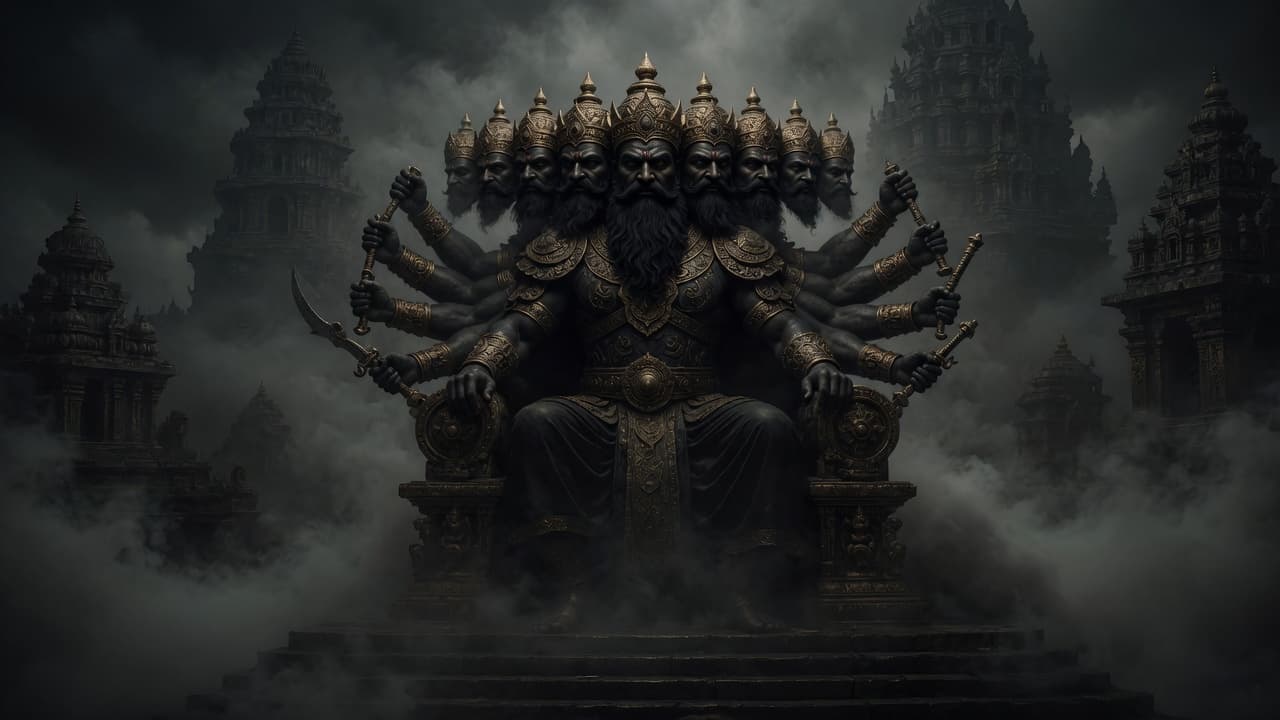
His ten heads are usually read as mastery of the six shastras and four Vedas: learning, not deformity. He is a formidable musician; one tradition credits him with the Shiva Tandava Stotram, a hymn of genuine beauty. When he once tried to lift Mount Kailasa and Shiva pinned him beneath it with a toe, he sang for a thousand years until Shiva released him and gave him his name.
He rules Lanka, which is described as a city of gold, and rules it well. His subjects are not oppressed.
Then he abducts Sita, and everything he built is spent. He does it in retaliation for the mutilation of his sister Shurpanakha, and he does not force Sita: he keeps her in the Ashoka grove and waits. What holds him back is a curse, not a further boon. In Valmiki's Uttarakanda, after Ravana rapes the apsaras Rambha, her husband Nalakuvara curses him that if lust drives him on a woman who does not love him, his head will split into seven pieces. A self-imposed vow not to touch an unwilling woman does appear in the Jain tradition (Vimalasuri's Paumacariya, as reported by A. K. Ramanujan); the epic curse and the Jain vow should be kept apart. He waits for a consent that never comes, and the war destroys him and his kingdom.
At his death Rama sends Lakshmana to sit at his feet and learn statecraft from him while he dies. The epic will not let him be merely defeated.
Where it comes from
Valmiki's Ramayana, in Sanskrit, is the foundational text: traditionally dated between roughly the fifth century BCE and the first century CE, with layers of composition. The Uttara Kanda, the final book, supplies most of Ravana's backstory, including the boon and the Kailasa episode, and is widely regarded as a later addition.
The Adhyatma Ramayana and Tulsidas's Ramcharitmanas, a sixteenth-century Awadhi retelling, shaped devotional understanding across North India.
Regional and Southeast Asian versions differ substantially. The Thai Ramakien, the Cambodian Reamker, the Javanese and Balinese traditions, and Jain Ramayanas each rework him, sometimes considerably more sympathetically.
Tamil tradition, and some Sri Lankan and Dravidian readings, treat Ravana as a wronged and capable king rather than a villain.
Motifs
The devout enemy
An opponent of the gods who is also learned, generous or genuinely devoted. The tradition refuses to make him simply wicked.
Also carried by: Hiranyakashipu (Hindu), Kumbhakarna (Hindu), Mahabali (Hindu)
The gift that undoes
Devotion earns a boon; the boon is worded too cleverly and becomes the exact shape of the giant's destruction.
Also carried by: Balor (Celtic / Irish), Hiranyakashipu (Hindu), Kumbhakarna (Hindu), Mahabali (Hindu)
Excess of body
Extra arms, heads, hands or fingers. Surplus anatomy marks a being as belonging to an older, less regulated order of creation.
What is disputed
Whether Ravana should be read as a villain at all is genuinely contested, and not only by modern commentators. Devotional traditions differ, and some communities in Sri Lanka and southern India regard him positively. Effigy-burning at Dussehra is not universal practice.
Whether he counts as a giant is a fair question. The Sanskrit describes a being of great stature and power, but rakshasa is its own category and the "giant" label is largely an artefact of European translation looking for an equivalent.
The Uttara Kanda's status affects everything. If it is a later addition, then the boon, the Kailasa episode and much of his characterisation postdate the core epic, and the original Ravana may have been a flatter antagonist.
Modern political readings, which variously make him a Dravidian king displaced by Aryan invaders or a symbol of resistance, are contemporary arguments using an ancient text and should be recognised as such.
Sources
- Valmiki, Ramayana (Sanskrit); Uttara Kanda for the boon and Kailasa episode
- Tulsidas, Ramcharitmanas (Awadhi, 16th c.)
- Ramakien (Thai) and Reamker (Cambodian) regional recensions
- Shiva Tandava Stotram, traditionally attributed to Ravana
Scholarly notes
Sources and scholarly notes come with the same membership.
Chain of custody
Every year at Dussehra, right across India, towering effigies of Ravana are packed with fireworks and set alight to mark the victory of good over evil.
The burning is thoroughly documented as a present-day practice, but the written trail for it thins fast as you go back, and the 'across India' half of the claim is contradicted by places that document their refusal to do it.
Mark for My Journey
Private marks. They are not a collection score.
Marks stay on this device for this session. Sign in to keep your marks.
Frequently asked
- Who was Ravana?
- Ravana is the ten-headed king of Lanka and the antagonist of the Ramayana: a rakshasa king, a scholar of the Vedas, a master of the veena, and a devotee of Shiva. Valmiki’s Ramayana is the foundational text; the Uttara Kanda supplies most of his backstory, including the boon and the Kailasa episode, and is widely regarded as a later addition.
- Was Ravana a giant?
- Whether he counts as a giant is a fair question. The Sanskrit describes a being of great stature and power, but rakshasa is its own category and the “giant” label is largely an artefact of European translation looking for an equivalent.
- Why does Ravana have ten heads?
- His ten heads are usually read as mastery of the six shastras and four Vedas: learning, not deformity.
- Why could the gods not kill Ravana?
- Through immense austerities he wins a boon from Brahma: he cannot be killed by gods, demons, rakshasas, gandharvas or any other supernatural being. He does not bother to include humans and animals. Vishnu incarnates as Rama, a man, and the boon holds perfectly while being useless.
- Is Ravana only a villain?
- Whether Ravana should be read as a villain at all is genuinely contested, and not only by modern commentators. Devotional traditions differ, and some communities in Sri Lanka and southern India regard him positively. Effigy-burning at Dussehra is not universal practice. At his death, Rama sends Lakshmana to sit at his feet and learn statecraft.