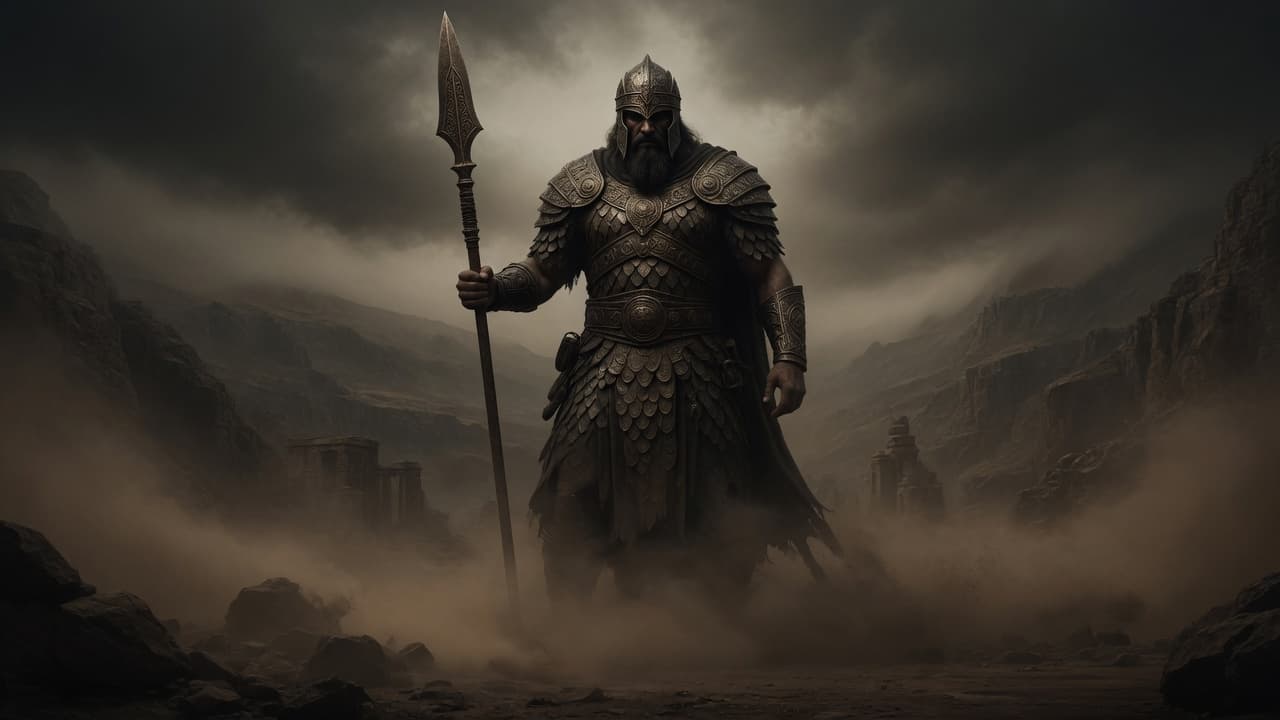
Goliath of Gath
Also known as: Goliath
Basic account
The Philistine champion of Gath who fell to a shepherd's stone.
Account
Goliath of Gath stands in the valley of Elah for forty days and challenges Israel to send one man against him. The armour is described piece by piece before the fight, which is how the story tells you what is about to be irrelevant.
The story
The Philistines and Israel face each other across the valley, each on a hill, neither willing to descend. Goliath proposes single combat to settle it: their champion against Israel's, winner takes the war.
1 Samuel 17 catalogues his equipment with unusual precision: a bronze helmet, a coat of mail weighing five thousand shekels, greaves, a bronze javelin, a spear whose shaft is like a weaver's beam with a head of six hundred shekels of iron, and a shield-bearer walking ahead of him. The inventory is doing work. It establishes a system of warfare, comprehensively.
David is a boy delivering bread and cheese to his brothers. He hears the challenge and volunteers. Saul offers his own armour; David tries it, cannot walk in it, and takes it off. He goes down to the brook, chooses five smooth stones, and approaches with a sling.
Goliath is insulted: "Am I a dog, that thou comest to me with staves?" David answers with a speech about whose battle it is. Then he runs at him, which is the tactical detail everyone forgets: he closes the distance while slinging rather than waiting to be reached.
The stone sinks into the forehead and Goliath falls face down. David takes the giant's own sword and cuts off his head. The Philistines break and run.
The story is not about strength. It is about a man who has optimised for one kind of fight meeting someone who declined to have it. A sling in trained hands was a genuine military weapon with real range: the mismatch is the reverse of how it looks.
Where it comes from
1 Samuel 17 is the main text. 1 Samuel 21:9 and 22:10 refer back to the sword kept at Nob.
The textual situation is complicated and important. The Septuagint version of 1 Samuel 17 is substantially shorter than the Masoretic Hebrew, usually put at around forty to forty-five per cent shorter rather than a clean half, and the two appear to preserve different stages of the story's development.
2 Samuel 21:19 states that Elhanan son of Jaare-oregim killed Goliath the Gittite. 1 Chronicles 20:5 adjusts this so that Elhanan kills Goliath's brother Lahmi: visibly a later harmonisation.
An inscription from tenth-to-ninth-century Tell es-Safi, the site generally identified as Gath, carries names close in form to Goliath. Aren Maeir reads both as resembling the biblical name; others are more cautious about how many names the sherd holds. What the sherd shows is that names like Goliath were in use at Gath in the right period. It does not by itself prove a securely Philistine etymology: proposed links run toward Anatolian and Egyptian forms as well, and the exact derivation remains disputed.
Motifs
Defeated by cunning
The giant loses to intelligence rather than strength: a trick, a false name, a riddle. Size is set up precisely so that it can fail.
Also carried by: Amazimu (Zulu / Nguni), Antaeus (Greek), Baqbaq-Devi (Georgian), British Giants: The Lesser Traditions (British and Welsh), Cormoran (Celtic / Cornish), Gogmagog (Celtic / British), Humbaba (Sumerian, Akkadian, later Hurrian and Hittite), Polyphemus (Greek), Rübezahl (German / Silesian / Czech), Shuten Dōji (Japanese), Skrymir (Norse), Stallo (Sámi), Talos (Greek), Tepegöz (Oghuz Turkic), The Gigantes (Greek), Thrym (Norse), Waligóra and Wyrwidąb (Polish)
War against the gods
Giants rise against the ruling powers and lose. The defeat is usually the point: it explains why the present order is the order.
Also carried by: Alcyoneus (Greek), Atlas (Greek), Balor (Celtic / Irish), Enceladus (Greek), Hiranyakashipu (Hindu), Hrungnir (Norse), Nephilim (Biblical / Near Eastern), Og of Bashan (Biblical / Near Eastern), Polybotes (Greek), Porphyrion (Greek), Thrym (Norse), Tityus (Greek), Xelhua (Mesoamerican)
What is disputed
Goliath's height differs between manuscripts. The Masoretic text gives six and a , around 2.9 metres. The Septuagint, the Dead Sea Scrolls fragment 4QSam-a and Josephus all give four and a , around 2 metres: tall but within human range. The six- figure is not only Masoretic: the Vulgate (around 400) and Targum Jonathan also read six, so the taller number was already in Hebrew exemplars centuries before the medieval codices. Whether the larger figure is the later reading is argued both ways: J. Daniel Hays has treated six as secondary; Gurry and Meade (2022) conclude the reverse. It is a live text-critical dispute, not a settled result.
Who killed him is a real problem in the text, not a modern invention. The Elhanan attribution in 2 Samuel is difficult to explain away, and the Chronicles version reads as an attempt to fix it.
Suggestions that Goliath had a pituitary disorder producing gigantism and visual field defects are medically coherent but entirely speculative, and rest on treating a literary description as a clinical record.
Sources
- 1 Samuel 17 (Masoretic Text); Septuagint 1 Kingdoms 17 (shorter version)
- 2 Samuel 21:19 and 1 Chronicles 20:5 (the Elhanan problem)
- 4QSam-a, Dead Sea Scrolls (height variant)
- Tell es-Safi/Gath ostracon, 10th-9th c. BCE (Philistine names)
Related finding: Goliath's height in the manuscripts
Part of
Scholarly notes
Sources and scholarly notes come with the same membership.
Chain of custody
Goliath of Gath stood six cubits and a span, about nine feet nine inches, or close to three metres.
The height is a textual variant rather than a fixed number: the surviving copies of 1 Samuel 17:4 do not agree with each other, and the disagreement is ancient.
Mark for My Journey
Private marks. They are not a collection score.
Marks stay on this device for this session. Sign in to keep your marks.
Frequently asked
- How tall was Goliath?
- The manuscripts disagree. The Masoretic text of 1 Samuel 17 gives six cubits and a span, around 2.9 metres. The Septuagint, the Dead Sea Scrolls fragment 4QSam-a and Josephus all give four cubits and a span, around 2 metres: tall but within human range. The six-cubit figure is also in the Vulgate and Targum Jonathan. Whether the larger figure is the later reading is a live text-critical dispute, not a settled result.
- Was Goliath a giant?
- 1 Samuel 17 catalogues armour and challenge, not a species label. One manuscript tradition puts him around 2.9 metres; another, equally ancient in its witnesses, puts him around 2 metres. Suggestions of a pituitary disorder producing gigantism are medically coherent but entirely speculative, and rest on treating a literary description as a clinical record.
- Who killed Goliath?
- 1 Samuel 17 is the main text: David. 2 Samuel 21:19 states that Elhanan son of Jaare-oregim killed Goliath the Gittite. 1 Chronicles 20:5 adjusts this so that Elhanan kills Goliath’s brother Lahmi: visibly a later harmonisation. Who killed him is a real problem in the text, not a modern invention.
- Does the Gath ostracon prove Goliath existed?
- An inscription from tenth-to-ninth-century Tell es-Safi, the site generally identified as Gath, carries names close in form to Goliath. What the sherd shows is that names like Goliath were in use at Gath in the right period. It does not by itself prove the champion of the story, nor a securely Philistine etymology.
- Why did David win?
- The story is not about strength. A sling in trained hands was a genuine military weapon with real range: the mismatch is the reverse of how it looks. David closes the distance while slinging rather than waiting to be reached.
Related giants
 Og of BashanBiblical / Near Eastern · Last of the Rephaim; king of Bashan whose iron bed was a wonder.
 NephilimBiblical / Near Eastern · The mighty ones of old: offspring of the sons of God and daughters of men.
 ʿUj ibn ʿAnāqIslamic tradition, Arabic and Persian · He is the biblical Og, after five centuries of retelling. By the end he was stan...