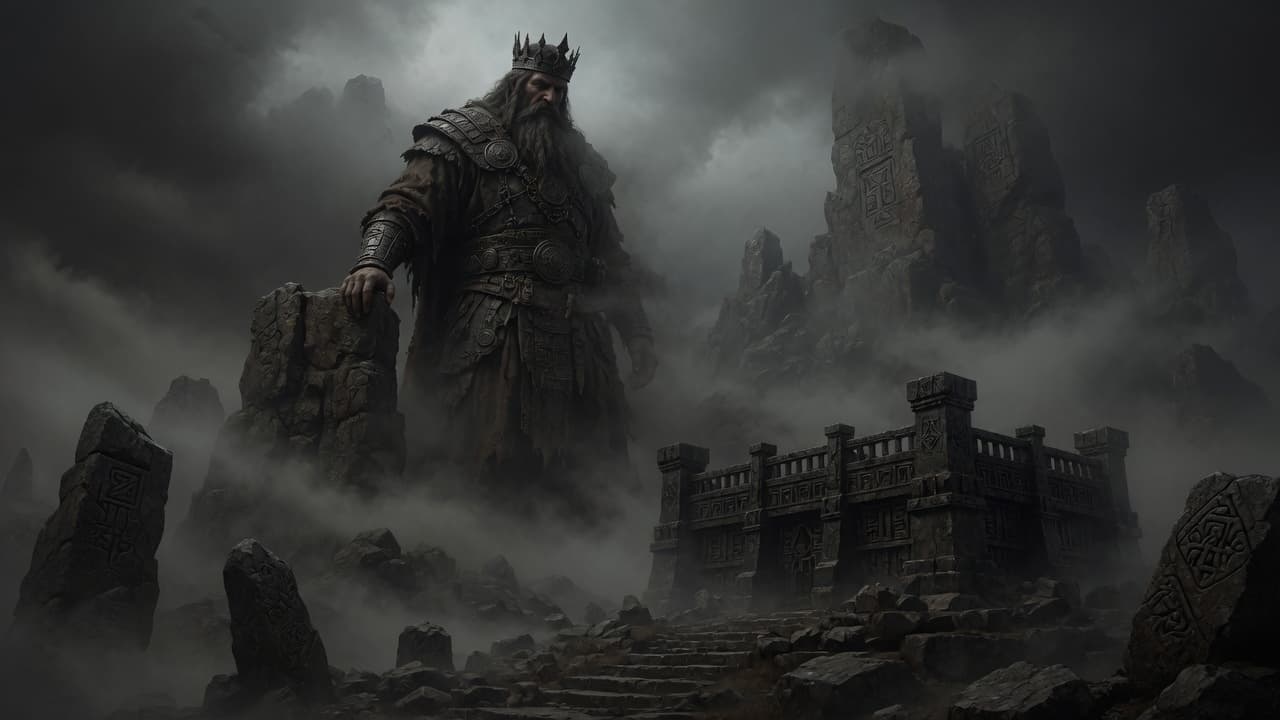
AI illustration
Og of Bashan
Also known as: Og
Basic account
Last of the Rephaim; king of Bashan whose iron bed was a wonder.
Account
Og, king of Bashan, is the last survivor of the Rephaim. Deuteronomy offers his iron bed as proof of his size, and notes that it can still be seen in Rabbah: a footnote that turns a king into an exhibit.
The story
Og rules Bashan, east of the Jordan, with sixty fortified cities. Israel meets him at Edrei, defeats him, and takes the territory. As conquest narratives go it is brief.
What makes Og memorable is the aside. Deuteronomy 3:11 pauses to observe that he alone remained of the remnant of the Rephaim, and that his bedstead was of iron, nine long and four wide, roughly four metres by two, and adds, almost conversationally, that it is still in Rabbah of the Ammonites.
That single verse does several things at once. It classifies him as the last of an older people. It gives a measurement of the object, not of Og: the verse nowhere states his height. And it points at something a reader could in principle go and look at, which is a form of evidence the Hebrew Bible rarely offers.
The Rephaim appear throughout the text as a pre-Israelite population of large stature, listed alongside the Anakim, the Emim and the Zamzummim: all named as earlier inhabitants displaced by later arrivals. Deuteronomy 2 is unusually systematic about this, working through which nation drove out which giants from which land.
Og's defeat becomes a fixed reference point. Psalms 135 and 136 name him in liturgical recitals of what God did for Israel, paired always with Sihon. He is remembered less as a person than as an item on a list of things overcome.
Later rabbinic tradition made him enormously larger. Niddah 61a says he was saved from the punishment of the generation of the flood; the familiar detail of his clinging to the outside of the ark is later midrashic elaboration rather than a line in the folio usually cited for the rest of the cycle.
Where it comes from
Numbers 21:33-35 records the battle at Edrei. Deuteronomy 3:1-13 gives the fuller account including the iron bedstead and the Rephaim classification. Joshua 12-13 lists the conquered territory.
Psalms 135:11 and 136:20 preserve him in liturgy, which indicates the tradition was well established.
The rabbinic expansions appear in the Talmud and in later midrash. Berakhot 54b carries the mountain-throwing; Niddah 24b the thighbone; Niddah 61a the flood survival. The ark-clinging detail is later midrashic. These make Og a figure of legendary scale and are clearly homiletic elaboration rather than historical claim.
The word rendered "bedstead" is read as a sarcophagus in some modern translations and commentaries. The ancient versions treat it as a bed: the Greek gives κλίνη, Jerome lectus, Onkelos ערסא. The sarcophagus reading is a modern preference, not an ancient consensus.
Motifs
The people who came before
Giants as an earlier race displaced by the present one. Often a way of accounting for ruins, large bones, or an older population.
Also carried by: Bestla (Norse), British Giants: The Lesser Traditions (British and Welsh), Croatian Giants: The Lesser Traditions (Croatian), Fangfeng (Chinese), Fomorians (Irish), Gogmagog (Celtic / British), Ispolini (Bulgarian), Jentilak (Basque), Kahui-Tipua (Māori), Kalev and Kalevipoeg (Estonian, Finnish, Karelian), Katallani (Albanian), Koljo (Finnish), Milžinai (Lithuanian), Mouros (Galician, Asturian, Portuguese), Nawao (Māori), Nemri (Croatian), Quinametzin (Mesoamerican / Aztec), Si-Te-Cah (Paiute), Surid ibn Salhouk (Coptic and Islamic Egypt, medieval), The Giants of Santa Elena (Manta, recorded by Spanish chroniclers), The Giants of the Canaries (European accounts of the Guanches), The Gigantes (Greek), The Patagonian Giants (European accounts of the Tehuelche and Selk'nam), Tombe dei Giganti (Sardinian), Uriași (Romanian), Ymir (Norse), ʿĀd, Iram and Thamud (Arabian and Islamic), ʿUj ibn ʿAnāq (Islamic tradition, Arabic and Persian), Nephilim (Biblical / Near Eastern)
Bones offered as evidence
Large remains, real fossils, misread burials, or claims that no one can now examine, put forward to prove the giants were literal.
Also carried by: Fangfeng (Chinese), Giant of Kandahar (Modern legend), Mapinguari (Amazonian, Brazilian), Quinametzin (Mesoamerican / Aztec), Si-Te-Cah (Paiute), The Giants of Santa Elena (Manta, recorded by Spanish chroniclers), The Giants of the Canaries (European accounts of the Guanches), ʿĀd, Iram and Thamud (Arabian and Islamic), Nephilim (Biblical / Near Eastern)
War against the gods
Giants rise against the ruling powers and lose. The defeat is usually the point: it explains why the present order is the order.
Also carried by: Alcyoneus (Greek), Atlas (Greek), Balor (Celtic / Irish), Enceladus (Greek), Goliath of Gath (Biblical / Philistine), Hiranyakashipu (Hindu), Hrungnir (Norse), Polybotes (Greek), Porphyrion (Greek), Thrym (Norse), Tityus (Greek), Xelhua (Mesoamerican), Nephilim (Biblical / Near Eastern)
What is disputed
Whether the iron object was a bed or a basalt sarcophagus is a live question. Basalt is common in the Bashan region, dark and iron-like in appearance, and a large stone sarcophagus would fit both the dimensions and the "still to be seen" remark. On that reading Deuteronomy is describing a monument, not furniture.
Who the Rephaim were is contested. The term is used both for a living people and, elsewhere in the Hebrew Bible and in Ugaritic texts, for shades of the dead: a double sense that may indicate an ancient population remembered as ancestral spirits, or two unrelated words.
The dolmens and megalithic structures scattered across the Golan and Transjordan have often been linked to the Rephaim traditions. The association is plausible as a mechanism, unexplained large structures inviting explanation by large builders, but is not demonstrated.
Sources
- Deuteronomy 3:1-13 (the iron bedstead at Rabbah); Numbers 21:33-35
- Joshua 12:4-5, 13:12; Psalms 135:11, 136:20
- Babylonian Talmud, Berakhot 54b, Niddah 24b, and Niddah 61a (rabbinic expansion)
- Ugaritic rpum texts (comparative evidence for the term)
Session Prep
Source shelf
- Deuteronomy 3:1-13 (the iron bedstead at Rabbah); Numbers 21:33-35
- Joshua 12:4-5, 13:12; Psalms 135:11, 136:20
- Babylonian Talmud, Berakhot 54b, Niddah 24b, and Niddah 61a (rabbinic expansion)
- Ugaritic rpum texts (comparative evidence for the term)
Compare
Related finding: Og's iron bed (Deuteronomy 3:11)
Part of
Scholarly notes
Scholarly notes stay with existing memberships.
Chain of custody
Deuteronomy records that Og of Bashan's iron bed was nine cubits long and four wide, and that measurement proves Og himself stood about four metres, roughly thirteen and a half feet.
The four metre figure is the length of an object, not a stated height: the verse measures the bed and leaves the man unmeasured, and the readers who converted bed into body disagreed with each other about how to do it.
Mark for My Journey
Private marks. They are not a collection score.
Marks stay on this device for this session. Sign in to keep your marks.
Related giants
 NephilimBiblical / Near Eastern · The mighty ones of old: offspring of the sons of God and daughters of men.
 Goliath of GathBiblical / Philistine · The Philistine champion of Gath who fell to a shepherd's stone.
 ʿUj ibn ʿAnāqIslamic tradition, Arabic and Persian · He is the biblical Og, after five centuries of retelling. By the end he was stan...