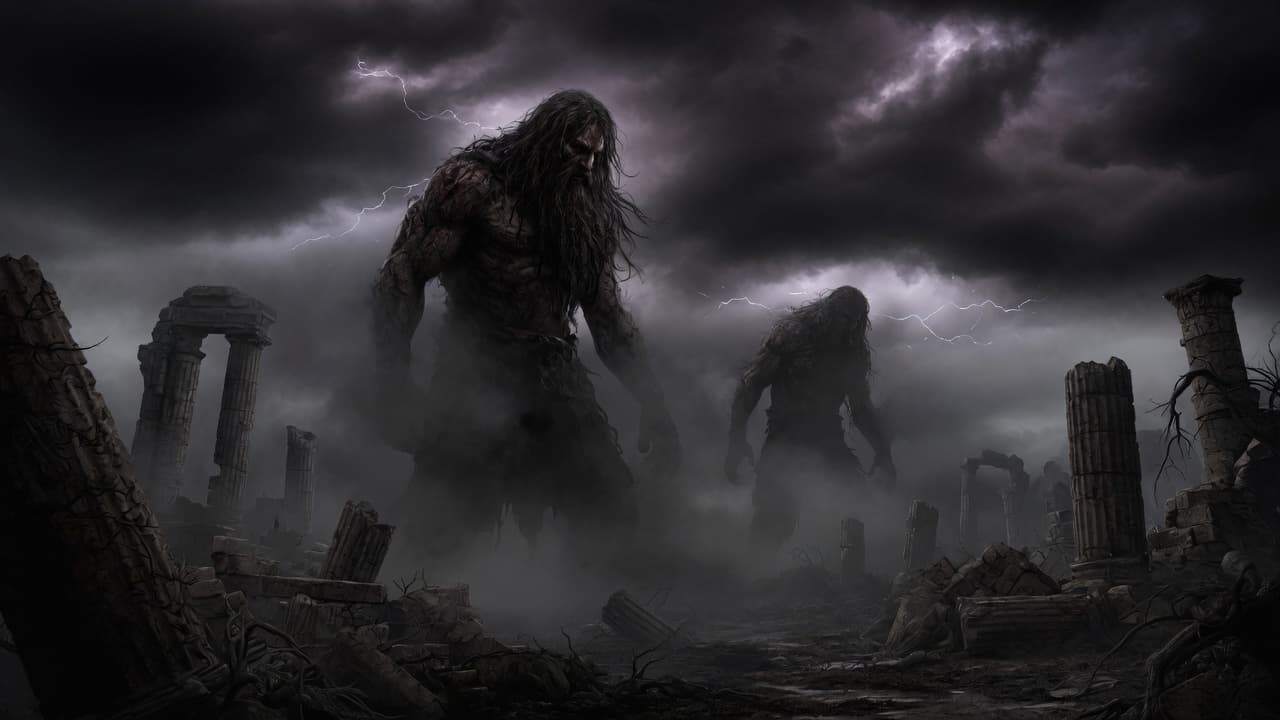
Nephilim
Also known as: The Fallen Ones, Gibborim
Basic account
The mighty ones of old: offspring of the sons of God and daughters of men.
Account
The Nephilim appear in Genesis in three verses and are never explained. They are on the earth before the flood, born after the sons of God go in to the daughters of men, and the text calls them the mighty men of old, men of renown.
The story
Genesis 6:1-4 is one of the strangest passages in the Hebrew Bible, partly because of what it says and mostly because of how quickly it stops saying it.
The sons of God see that the daughters of men are fair and take wives from among them. The Nephilim are on the earth in those days, and also afterward. The verses sit immediately before God's decision to destroy the world by flood, and the connection is implied but never stated.
Then the text moves on. No genealogy, no episode, no explanation of what the Nephilim were or what they did. The whole thing is four verses and it reads like a fragment of something much larger that the compiler either did not know or chose not to include.
The word itself is not translated. Nephilim is usually connected to the Hebrew root n-p-l, to fall, giving "the fallen ones": though whether that means fallen in status, fallen from heaven, or those who cause others to fall is not determinable from the word alone. The Septuagint translators rendered it , giants, and that decision shaped two thousand years of reading.
They reappear once, in Numbers 13:33, when the spies sent into Canaan report seeing the Nephilim and say that they seemed like grasshoppers beside them. This is a bad report given by frightened men, and the text frames it as such, but it establishes the image that stuck.
Later Jewish tradition, particularly the Book of Enoch, filled the silence with an enormous amount of material: named angels, taught forbidden knowledge, monstrous offspring, and a war in heaven.
Where it comes from
Genesis 6:1-4 and Numbers 13:33 are the whole of the biblical material.
The Book of Enoch, a non-canonical Jewish work whose earliest sections date from roughly the third to first centuries BCE, is the major expansion. Its Watchers narrative names the angels who descended, describes their teaching of metallurgy, cosmetics and sorcery, and makes their offspring devouring giants. Fragments were found among the Dead Sea Scrolls, confirming its currency in the Second Temple period.
The Book of Jubilees covers similar ground. The Septuagint's choice of carried the giant reading into Greek and then Latin Christianity.
Josephus, in Antiquities of the Jews I.3.1, refers to the tradition of angels who consorted with women and begat unjust sons, comparing them to those "whom the Grecians call Giants." The bones "still shown to this very day" are elsewhere: Antiquities V.2.3 (5.125), on the taking of Hebron, where he describes the race of giants and their remains.
Motifs
War against the gods
Giants rise against the ruling powers and lose. The defeat is usually the point: it explains why the present order is the order.
Also carried by: Alcyoneus (Greek), Atlas (Greek), Balor (Celtic / Irish), Enceladus (Greek), Goliath of Gath (Biblical / Philistine), Hiranyakashipu (Hindu), Hrungnir (Norse), Polybotes (Greek), Porphyrion (Greek), Thrym (Norse), Tityus (Greek), Xelhua (Mesoamerican), Og of Bashan (Biblical / Near Eastern)
Survivor of the flood
A giant or giant-descended line survives a deluge that destroys the rest of its kind, and so carries the old world into the new one.
Bones offered as evidence
Large remains, real fossils, misread burials, or claims that no one can now examine, put forward to prove the giants were literal.
Also carried by: Fangfeng (Chinese), Giant of Kandahar (Modern legend), Mapinguari (Amazonian, Brazilian), Quinametzin (Mesoamerican / Aztec), Si-Te-Cah (Paiute), The Giants of Santa Elena (Manta, recorded by Spanish chroniclers), The Giants of the Canaries (European accounts of the Guanches), ʿĀd, Iram and Thamud (Arabian and Islamic), Og of Bashan (Biblical / Near Eastern)
The people who came before
Giants as an earlier race displaced by the present one. Often a way of accounting for ruins, large bones, or an older population.
Also carried by: Bestla (Norse), British Giants: The Lesser Traditions (British and Welsh), Croatian Giants: The Lesser Traditions (Croatian), Fangfeng (Chinese), Fomorians (Irish), Gogmagog (Celtic / British), Ispolini (Bulgarian), Jentilak (Basque), Kahui-Tipua (Māori), Kalev and Kalevipoeg (Estonian, Finnish, Karelian), Katallani (Albanian), Koljo (Finnish), Milžinai (Lithuanian), Mouros (Galician, Asturian, Portuguese), Nawao (Māori), Nemri (Croatian), Quinametzin (Mesoamerican / Aztec), Si-Te-Cah (Paiute), Surid ibn Salhouk (Coptic and Islamic Egypt, medieval), The Giants of Santa Elena (Manta, recorded by Spanish chroniclers), The Giants of the Canaries (European accounts of the Guanches), The Gigantes (Greek), The Patagonian Giants (European accounts of the Tehuelche and Selk'nam), Tombe dei Giganti (Sardinian), Uriași (Romanian), Ymir (Norse), ʿĀd, Iram and Thamud (Arabian and Islamic), ʿUj ibn ʿAnāq (Islamic tradition, Arabic and Persian), Og of Bashan (Biblical / Near Eastern)
What is disputed
What the sons of God are is the central unresolved question. The three main readings (divine or angelic beings, the righteous line of Seth intermarrying with the line of Cain, or dynastic rulers claiming divine descent) have each been the majority view at different periods, and the Hebrew supports all three.
Whether the Nephilim are the offspring of that union or simply present at the same time is grammatically ambiguous in the Hebrew. Most translations imply causation the text does not clearly state.
"And also afterward" in Genesis 6:4 is a genuine problem, since it appears to place them after a flood that killed everything. Explanations range from a second incursion to an editorial insertion harmonising with Numbers 13.
Modern claims that giant skeletons confirm the Nephilim are a distinct phenomenon with no scholarly standing. They rest on misidentified fossils, hoaxes and doctored photographs; no verified remains exist.
Sources
- Genesis 6:1-4; Numbers 13:33 (Hebrew Bible)
- 1 Enoch, the Book of the Watchers, chapters 6-16 (3rd-1st c. BCE)
- Book of Jubilees 5; Dead Sea Scrolls Enoch fragments
- Josephus, Antiquities of the Jews I.3.1 (tradition); V.2.3 / 5.125 (bones at Hebron)
Part of
Scholarly notes
Sources and scholarly notes come with the same membership.
Chain of custody
The nephilim of Genesis 6 were giants: enormous hybrid offspring born when the sons of God took human wives, whose kind the Israelite spies later saw and felt like grasshoppers beside.
The giant reading is genuinely ancient and continuously attested, but it travels on translation and on expansion literature rather than on the wording of the Hebrew verse.
Mark for My Journey
Private marks. They are not a collection score.
Marks stay on this device for this session. Sign in to keep your marks.
Frequently asked
- What does Genesis actually say about the Nephilim?
- Genesis 6:1–4 is the core: the sons of God see that the daughters of men are fair and take wives from among them; the Nephilim are on the earth in those days, and also afterward; the text calls them the mighty men of old, men of renown. The verses sit immediately before the flood decision; the connection is implied but never stated. They reappear once, in Numbers 13:33, in a spies’ report the text frames as a bad report given by frightened men.
- Were the Nephilim giants?
- The Hebrew word is not translated. It is usually connected to the root n-p-l, to fall, giving “the fallen ones.” The Septuagint translators rendered it gigantes, giants, and that decision shaped two thousand years of reading. The giant reading is genuinely ancient, but it travels on translation and on expansion literature rather than on the wording of the Hebrew verse.
- Who were the sons of God in Genesis 6?
- That is the central unresolved question. The three main readings are divine or angelic beings, the righteous line of Seth intermarrying with the line of Cain, or dynastic rulers claiming divine descent; each has been the majority view at different periods, and the Hebrew supports all three. Whether the Nephilim are the offspring of that union or simply present at the same time is grammatically ambiguous.
- How tall were the Nephilim?
- Genesis never measures them. Later Jewish tradition, particularly the Book of Enoch, filled the silence with named angels, forbidden knowledge, and devouring giant offspring. Modern claims that giant skeletons confirm the Nephilim rest on misidentified fossils, hoaxes and doctored photographs; no verified remains exist.
- Did the Nephilim survive the flood?
- “And also afterward” in Genesis 6:4 is a genuine problem, since it appears to place them after a flood that killed everything. Explanations range from a second incursion to an editorial insertion harmonising with Numbers 13. The page does not choose among them.
Related giants
 Og of BashanBiblical / Near Eastern · Last of the Rephaim; king of Bashan whose iron bed was a wonder.
 Goliath of GathBiblical / Philistine · The Philistine champion of Gath who fell to a shepherd's stone.
 ʿĀd, Iram and ThamudArabian and Islamic · The peoples the Qur'an says were destroyed for arrogance. It does not say they w...