Paul Bunyan
Basic account
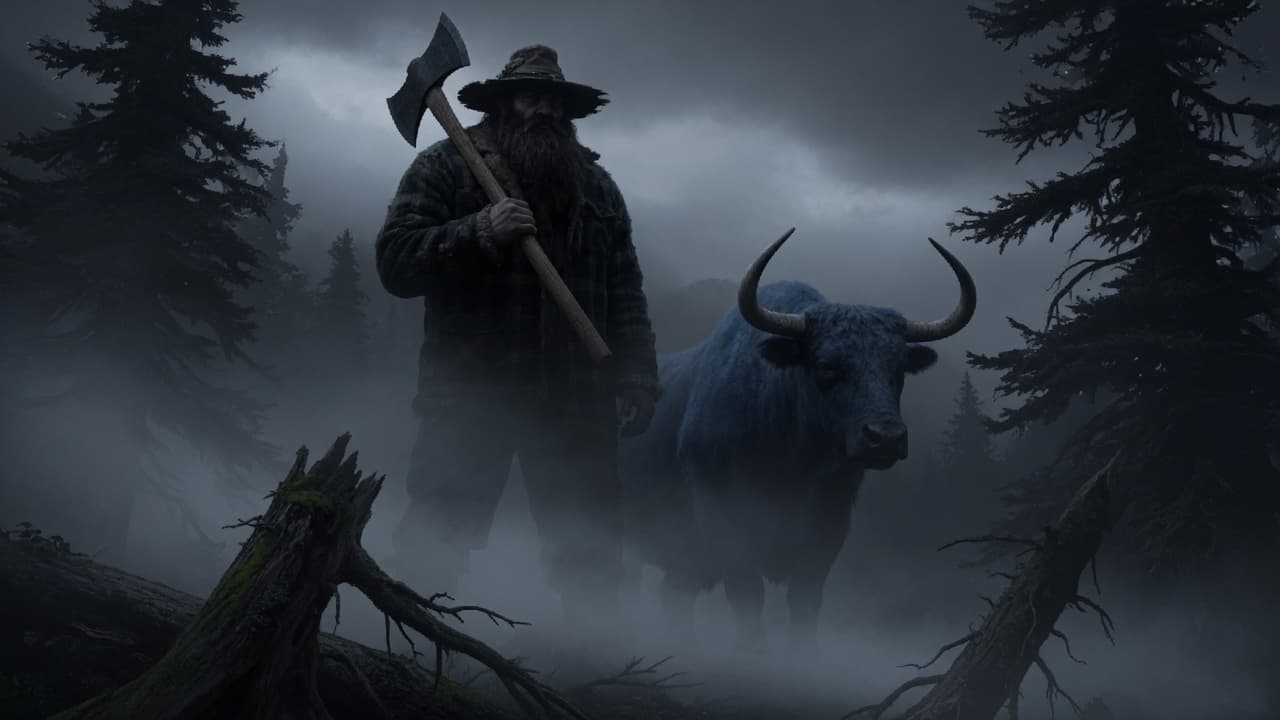
Lumberjack giant of American tall tales: Babe the Blue Ox at his side.
Account
Paul Bunyan is a giant lumberjack with a blue ox named Babe. He is the best-known giant in American folklore and substantially an advertising creation, which is the most interesting thing about him.
The story
The Paul Bunyan of popular knowledge scoops out the Great Lakes to water Babe, drags his axe behind him and gouges the Grand Canyon, and creates the ten thousand lakes of Minnesota with his and Babe's footprints. He clears forests at impossible speed. His griddle is greased by men skating across it with bacon strapped to their feet.
None of it asks to be believed. The tall tale is a genre with its own contract: the teller exaggerates, the listener knows, and the pleasure is in the escalation. This makes Bunyan structurally different from every other entry in this codex. He is not a belief that faded into story. He was a joke from the beginning.
His origins are genuinely in the logging camps of the Great Lakes region and eastern Canada, where oral tall tales about an outsized lumberjack circulated among workers in the later nineteenth century. That much is accepted.
What happened next is unusual. In 1916 the Red River Lumber Company, a California logging firm, began publishing promotional pamphlets written by an advertising man named William Laughead, featuring Paul Bunyan as a mascot. Laughead invented a great deal: Babe the Blue Ox appears to be substantially his, along with several of the supporting characters and much of the material now considered traditional.
The advertising Bunyan then escaped into general culture and became folklore in reverse: a commercial character absorbed into the national repertoire, taught in schools, and commemorated in enormous roadside statues across the northern United States.
Folklorists have argued about him for a century, with some calling the whole thing fakelore. He is a giant made of marketing that people genuinely adopted.
Where it comes from
Oral tall tales among lumber workers in the Great Lakes region and eastern Canada, later nineteenth century, are the genuine substrate. Documentation of this phase is thin.
Early print appearances include a 1910 newspaper piece by James MacGillivray in the Detroit News-Tribune.
William Laughead's promotional pamphlets for the Red River Lumber Company, from 1916 onward, are the decisive intervention and introduced much of the now-standard material including Babe.
Later literary treatments by Esther Shephard, James Stevens and others consolidated the figure. Richard Dorson's critique, coining the term fakelore, is the central scholarly intervention.
Motifs
Knowingly tall tale
Exaggeration that never asked to be believed. The audience and the teller are both in on it, which makes it a different kind of story.
The land is the body
A named hill, lake or island is understood as a being, not merely as its memorial. The country is read as a person.
Also carried by: Budj Bim Giants (Australian Aboriginal (Gunditjmara related landscape)), Kahui-Tipua (Māori), Kua Fu (Chinese)
The giant as builder
Walls, causeways, dolmens and bridges attributed to giants: usually structures whose real makers had been forgotten.
Also carried by: Budj Bim Giants (Australian Aboriginal (Gunditjmara related landscape)), Croatian Giants: The Lesser Traditions (Croatian), Dragonja (Croatian), Gargantua (French), Jentilak (Basque), Mouros (Galician, Asturian, Portuguese), Quinametzin (Mesoamerican / Aztec), Surid ibn Salhouk (Coptic and Islamic Egypt, medieval), The Cailleach (Gaelic: Irish, Scottish, Manx), Tombe dei Giganti (Sardinian), Xelhua (Mesoamerican)
What is disputed
How much of Bunyan is authentically traditional and how much is Laughead's is the long-running argument. The oral substrate is accepted; its content is poorly documented, which makes the boundary hard to draw.
Richard Dorson's charge of fakelore has been influential and also contested. Critics argue that the distinction between authentic and commercial tradition is less clean than Dorson allowed, and that material genuinely adopted by a public is folklore whatever its origin.
Regional claims to Bunyan's origin (Michigan, Minnesota, Wisconsin, Maine, Quebec) are numerous, competitive and mostly commercially motivated.
Some early logging-camp material was rough and, by modern standards, offensive in ways later versions removed. The sanitised children's Bunyan is itself a further layer of construction.
Sources
- Great Lakes logging-camp oral tradition, late 19th c.
- James MacGillivray, Detroit News-Tribune (1910)
- William Laughead, Red River Lumber Company pamphlets (1916 onward)
- Richard Dorson, on fakelore (mid-20th c. critique)
Scholarly notes
Sources and scholarly notes come with the same membership.
Mark for My Journey
Private marks. They are not a collection score.
Marks stay on this device for this session. Sign in to keep your marks.