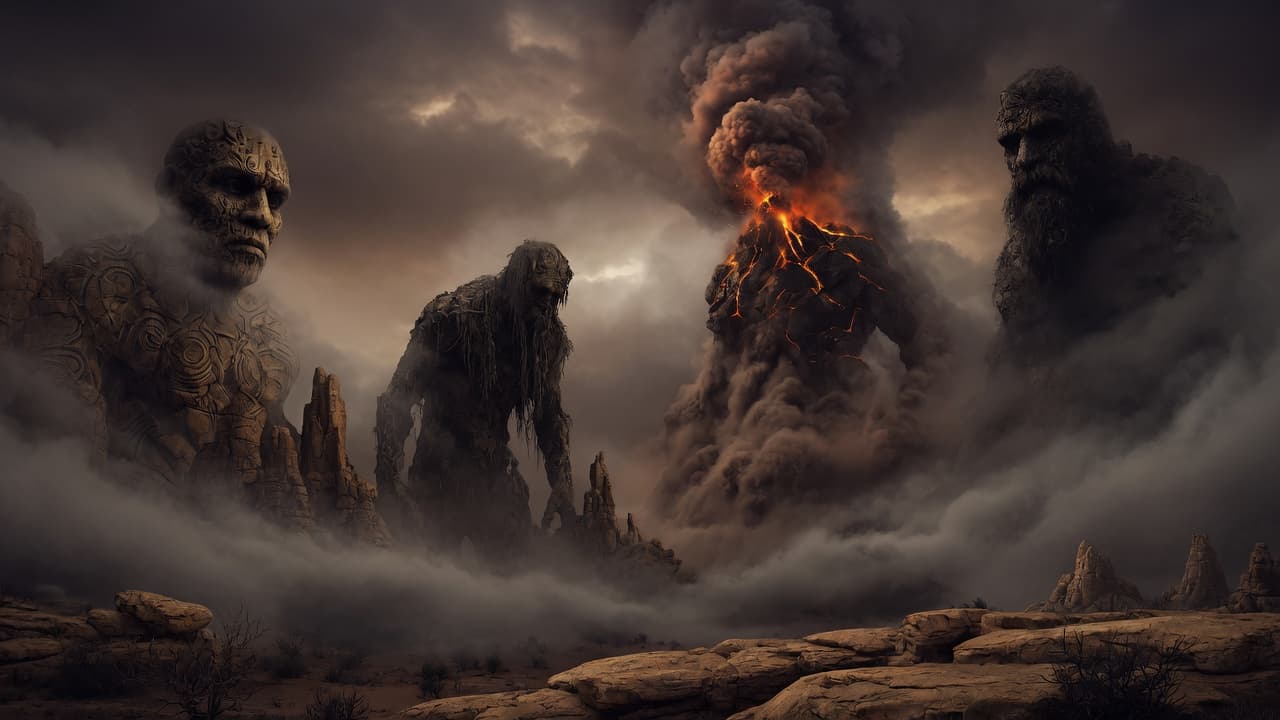
Budj Bim Giants
Also known as: Associated with Budj Bim / Tyrendarra country
Basic account
Ancestral beings of giant scale in the volcanic landscape of Budj Bim.
Account
Budj Bim is a volcano in south-west Victoria, and in Gunditjmara tradition it is an ancestral being who revealed himself in the landscape. The lava he produced carries one of the oldest aquaculture systems known anywhere.
The story
This entry is different from the others in the codex, because most of it is verifiable.
Gunditjmara tradition holds that Budj Bim is a creation being who revealed himself, and the surrounding landscape records that revelation. The name is commonly translated as "high head". The volcano erupted, and the lava flow it produced is the ground everything else sits on.
The eruption is dated by geological methods to roughly thirty-seven thousand years ago. Gunditjmara people were present. That makes the tradition, in the reading now widely accepted by geologists and archaeologists working with the community, one of the oldest continuously held accounts of an actual event anywhere on earth.
What the Gunditjmara built on that lava is the other half. Across the wetlands they constructed an extensive system of channels, weirs and holding ponds to trap, store and harvest kooyang: short-finned eel. Parts of it are dated to around six thousand five hundred years old. It supported permanent stone dwellings and a settled population, which comprehensively contradicts the long-standing colonial claim that Aboriginal Australians were universally nomadic and built nothing.
The Budj Bim Cultural Landscape was inscribed as a UNESCO World Heritage site in 2019, on cultural criteria, nominated with and managed by the Gunditjmara.
So the "giant" here is a mountain that is a person, remembered accurately across an interval that beggars comparison, by people who then engineered the country around it. Almost nothing else in this collection is that solid.
Where it comes from
Gunditjmara oral tradition, held by the community and central to the World Heritage nomination.
Geological dating of the Budj Bim, Mount Eccles, eruption places it in the range of tens of thousands of years before present; published argon-argon dating has given figures around thirty-seven thousand years.
Archaeological work on the aquaculture systems has been conducted over decades in partnership with the Gunditjmara, with radiocarbon dates for parts of the system around six thousand five hundred years old.
UNESCO World Heritage inscription documentation (2019) sets out both the cultural traditions and the physical evidence. The Gunditj Mirring Traditional Owners Aboriginal Corporation is the managing body.
Motifs
The land is the body
A named hill, lake or island is understood as a being, not merely as its memorial. The country is read as a person.
Also carried by: Kahui-Tipua (Māori), Kua Fu (Chinese), Paul Bunyan (American tall-tale)
The giant as builder
Walls, causeways, dolmens and bridges attributed to giants: usually structures whose real makers had been forgotten.
Also carried by: Croatian Giants: The Lesser Traditions (Croatian), Dragonja (Croatian), Gargantua (French), Jentilak (Basque), Mouros (Galician, Asturian, Portuguese), Paul Bunyan (American tall-tale), Quinametzin (Mesoamerican / Aztec), Surid ibn Salhouk (Coptic and Islamic Egypt, medieval), The Cailleach (Gaelic: Irish, Scottish, Manx), Tombe dei Giganti (Sardinian), Xelhua (Mesoamerican)
Turned to stone
A giant becomes a rock, hill or island. The landscape is offered as the surviving evidence, which is what makes the story durable.
Also carried by: Cormoran (Celtic / Cornish), Croatian Giants: The Lesser Traditions (Croatian), Klek (Croatian), The Cailleach (Gaelic: Irish, Scottish, Manx), Tröll (Icelandic)
What is disputed
The eruption date and the aquaculture dates are established by standard scientific methods and are not seriously contested. What is discussed is precision, not the general picture.
The claim that the tradition records the eruption itself is widely accepted but rests on the alignment of tradition with dating rather than on a direct chain of evidence, and careful writers phrase it accordingly.
The extent and chronology of the aquaculture system continue to be refined by ongoing research; earlier phases may yet be dated older.
Cultural protocols apply. Some Gunditjmara knowledge is not for general publication, and the community determines what is shared. This entry deliberately stays with what has been made public by the Traditional Owners and in the World Heritage documentation.
Sources
- Gunditjmara tradition, via Gunditj Mirring Traditional Owners Aboriginal Corporation
- UNESCO World Heritage inscription, Budj Bim Cultural Landscape (2019)
- Published argon-argon dating of the Budj Bim eruption
- Archaeological literature on the Budj Bim aquaculture systems
- AIATSIS protocols for Indigenous knowledge
Whether this material should appear in a general catalogue at all is a fair question. We have kept a short entry rather than deleting it silently, because the gap and the reason for it are worth showing, but we would remove or correct it on request from the relevant community. Requests can be sent to hello@giantscodex.com.
Mark for My Journey
Private marks. They are not a collection score.
Marks stay on this device for this session. Sign in to keep your marks.
Related giants
 PapinijuwariAustralian Aboriginal (Tiwi) · One-eyed giant spirits of Tiwi tradition who hunt with clubs and bags.
 MurkupangAustralian Aboriginal · Giant figure in northern Australian story cycles of pursuit and country.
 Thardid JimboAustralian Aboriginal · Cannibal giant of southeastern Aboriginal tales: a terror of the camp edge.