Jentilak
Also known as: Jentil, Olentzero (related tradition)
Basic account
Basque giants of the mountains who built megaliths and fled the new faith.
Account
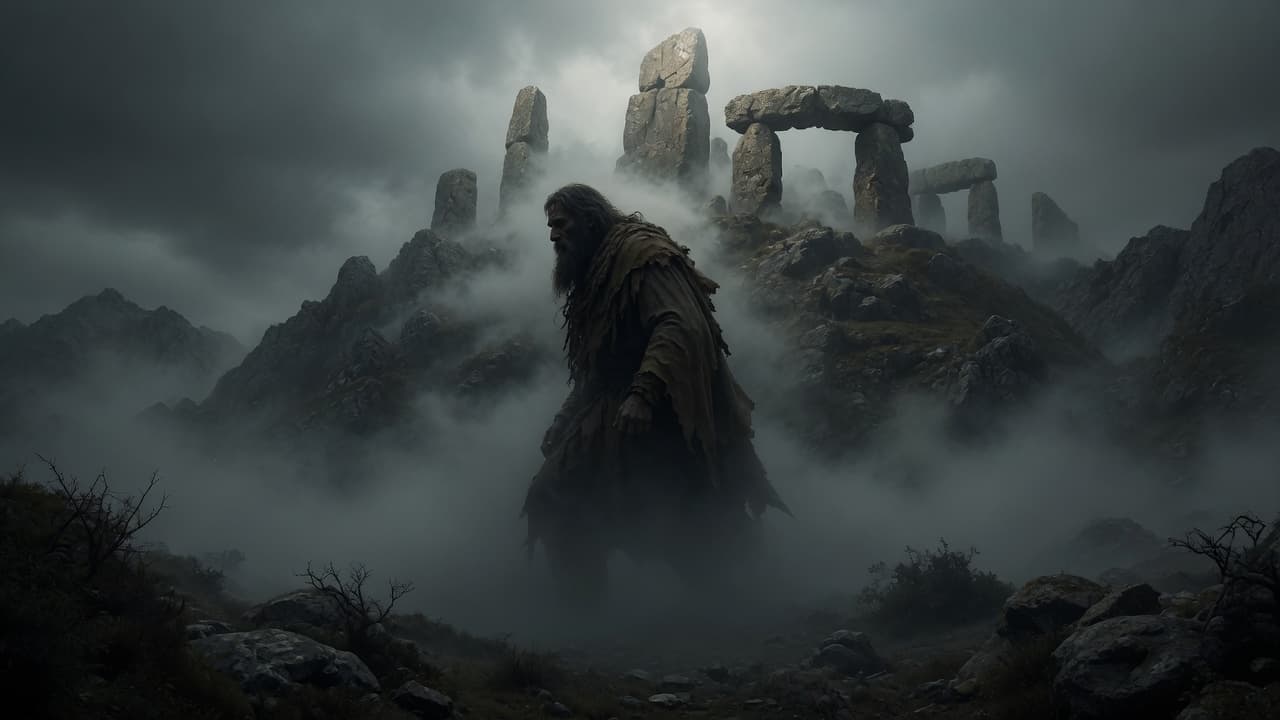
The Jentilak are the giants of Basque tradition who lived alongside people, taught them ironwork and the cultivation of wheat, and left when Christianity came. The dolmens scattered across the Basque hills are their work.
The story
Basque folklore is unusual in that its giants are neighbours rather than enemies.
The Jentilak are enormous, strong, hairy, and live in the mountains. They throw stones over great distances, a standard explanation for erratic boulders and megaliths, and they are credited with the dolmens and stone circles found throughout the Basque Country and Navarre, which are called jentil etxe, giants' houses, or jentilarri.
They are also teachers. Several traditions credit them with bringing metalworking, the scythe, the saw, and the growing of wheat to people. This is a rare arrangement: giants as the origin of technology rather than an obstacle to it.
The end of the Jentilak is the striking part. A bright cloud appears in the sky, and the giants, unable to look at it, ask their oldest and blindest elder what it means. He has his eyelids propped open, looks, and says that Kixmi has been born and they must all flee. Kixmi is understood as a name for Christ, and the word is glossed as "monkey" in some tellings. The old giant asks to be thrown down the hill, and the Jentilak run and are gone.
One remains: Olentzero, who stays behind and becomes a Christmas figure.
The pattern of a pre-Christian people withdrawing at the moment of conversion is found elsewhere in Europe, but the Basque version is unusually explicit. It reads as a tradition describing its own supersession, and doing so with some regret.
Where it comes from
Basque oral tradition, collected systematically in the twentieth century. José Miguel de Barandiarán, the ethnographer and archaeologist who spent decades recording Basque folklore, is the principal source for most of what is now known, and his fieldwork underpins nearly all later accounts.
Resurrección María de Azkue's collections are the other major body of material.
Place-names across the Basque Country and Navarre preserve the tradition directly: jentilbaratza, jentiletxe, and similar forms attached to megalithic sites.
The Jentilak are embedded in the wider Basque mythological system alongside Mari, Sugaar and the lamiak, which Barandiarán reconstructed as a coherent body.
Motifs
The giant as builder
Walls, causeways, dolmens and bridges attributed to giants: usually structures whose real makers had been forgotten.
Also carried by: Budj Bim Giants (Australian Aboriginal (Gunditjmara related landscape)), Croatian Giants: The Lesser Traditions (Croatian), Dragonja (Croatian), Gargantua (French), Mouros (Galician, Asturian, Portuguese), Paul Bunyan (American tall-tale), Quinametzin (Mesoamerican / Aztec), Surid ibn Salhouk (Coptic and Islamic Egypt, medieval), The Cailleach (Gaelic: Irish, Scottish, Manx), Tombe dei Giganti (Sardinian), Xelhua (Mesoamerican)
The people who came before
Giants as an earlier race displaced by the present one. Often a way of accounting for ruins, large bones, or an older population.
Also carried by: Bestla (Norse), British Giants: The Lesser Traditions (British and Welsh), Croatian Giants: The Lesser Traditions (Croatian), Fangfeng (Chinese), Fomorians (Irish), Gogmagog (Celtic / British), Ispolini (Bulgarian), Kahui-Tipua (Māori), Kalev and Kalevipoeg (Estonian, Finnish, Karelian), Katallani (Albanian), Koljo (Finnish), Milžinai (Lithuanian), Mouros (Galician, Asturian, Portuguese), Nawao (Māori), Nemri (Croatian), Nephilim (Biblical / Near Eastern), Og of Bashan (Biblical / Near Eastern), Quinametzin (Mesoamerican / Aztec), Si-Te-Cah (Paiute), Surid ibn Salhouk (Coptic and Islamic Egypt, medieval), The Giants of Santa Elena (Manta, recorded by Spanish chroniclers), The Giants of the Canaries (European accounts of the Guanches), The Gigantes (Greek), The Patagonian Giants (European accounts of the Tehuelche and Selk'nam), Tombe dei Giganti (Sardinian), Uriași (Romanian), Ymir (Norse), ʿĀd, Iram and Thamud (Arabian and Islamic), ʿUj ibn ʿAnāq (Islamic tradition, Arabic and Persian)
What is disputed
The material was collected late, and how much reflects genuinely old tradition versus nineteenth and twentieth-century consolidation is a real question. Barandiarán was a careful fieldworker, but he was also organising scattered accounts into a system, and the system may be tidier than what he found. One case is documented. A detail about the burning of the Lesaka effigy, reported by Caro Baroja in 1946, was later repeated by Barandiarán without attribution.
Whether the Kixmi episode is pre-Christian tradition remembering conversion, or a Christian-era story constructed about it, cannot be determined. It obviously postdates Christianity in its present form.
The association with dolmens is a folk explanation of megalithic remains, of the same kind found across Europe. It tells us how people accounted for the monuments, not who built them: they are Neolithic, and predate the tradition by millennia.
The etymology of Jentil, from Latin gentilis meaning pagan or gentile, indicates the name at least is post-Roman.
Sources
- José Miguel de Barandiarán, Basque mythology fieldwork and collections (20th c.)
- Resurrección María de Azkue, Euskalerriaren Yakintza (1935-47)
- Basque and Navarrese megalithic place-names (jentiletxe, jentilarri)
- Anton Erkoreka, Los gentiles: el mito de los gigantes en el País Vasco, Cuadernos de Etnología y Etnografía de Navarra 23 (1976)
- Anuntxi Arana, Euskal mitologiaz: jentilak eta kristauak (2008)
- Emilio Xabier Dueñas, 'El carbonero Olentzero y el obispo (San) Nicolás', Eusko Ikaskuntza, Lankidetzan 41
Mark for My Journey
Private marks. They are not a collection score.
Marks stay on this device for this session. Sign in to keep your marks.
Related giants
 OlentzeroBasque · The Basque charcoal-burner of Christmas: last echo of the jentilak.
 OjáncanuCantabrian · One-eyed Cantabrian giant of the forest: enemy of the good anjana.
 The CailleachGaelic: Irish, Scottish, Manx · The Neolithic passage tombs at Loughcrew are said to be stones that fell out of ...