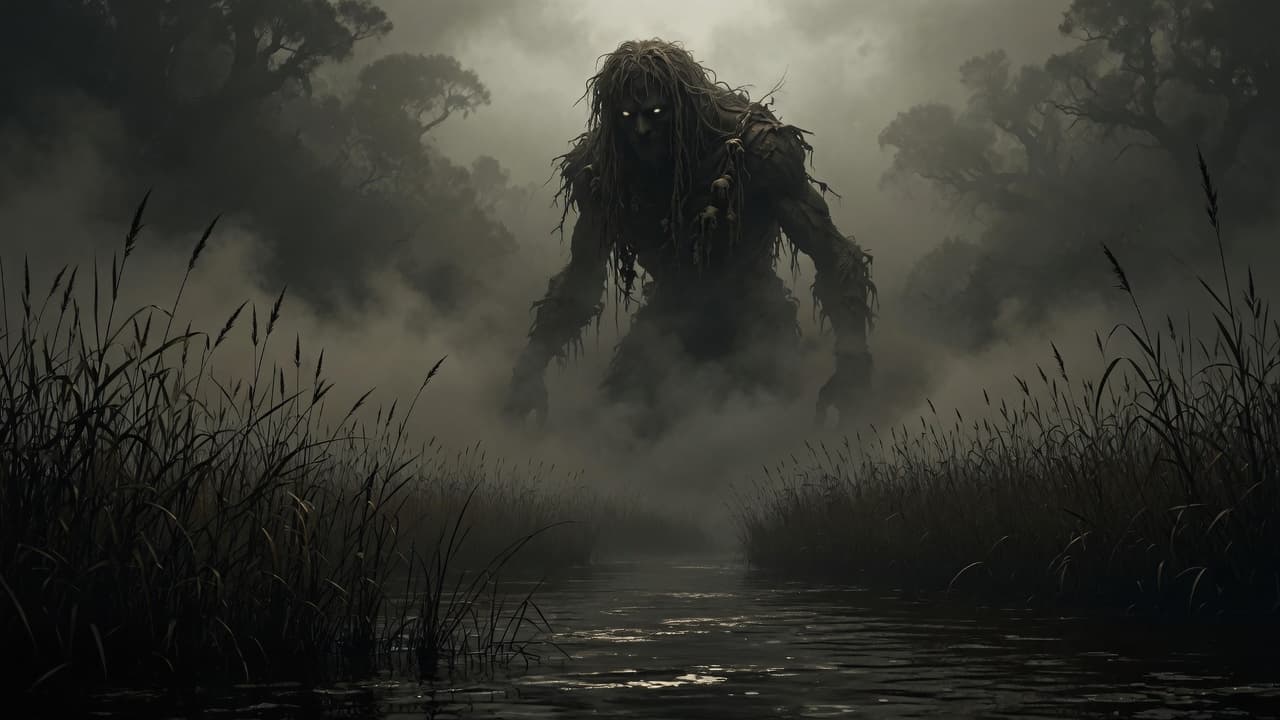
Thardid Jimbo
Basic account
Cannibal giant of southeastern Aboriginal tales: a terror of the camp edge.
Account
Thardid Jimbo is recorded as a giant of Australian Aboriginal tradition, over two metres tall, who hunted people and was killed after taking a woman as a wife. The record has the same attribution problems as its neighbours.
The story
The narrative recorded under this name describes a large man-eating being who takes a woman, in some tellings a woman already married, and is eventually killed, in several versions after his intended prey or her kin outwit him.
As with Murkupang, the material reaches general reference through twentieth-century compilations that did not adequately identify the community it came from, and we are not able to attribute it with confidence.
There is a general point worth making here rather than repeating it entry by entry.
Australian Aboriginal cultures are the oldest continuous cultures on earth, with traditions that in documented cases, Budj Bim in this same codex, preserve accurate memory of events tens of thousands of years old. They are not a source of generic monster stories. Treating them as raw material for a curiosity catalogue, which is exactly what much of the twentieth-century publishing did, is both inaccurate and disrespectful.
The cannibal-giant figures are real traditions with real functions: marking dangerous country, instructing children, encoding law. Detached from the people, the place and the language, almost all of that is lost, and what remains is a monster with a name.
We are keeping short entries for these rather than removing them, so that the shape of the problem stays visible instead of being tidied away. Fuller and better-sourced treatment would require working with the relevant communities, which is a real undertaking and not one we can shortcut.
Where it comes from
Australian Aboriginal oral tradition; specific community not reliably identified in available sources.
The name appears in mid-twentieth-century compilations of Australian Aboriginal legend, with the attribution and consent problems described above.
Community-controlled sources and language centres are the appropriate authority.
AIATSIS holds relevant collections and maintains protocols governing use of Indigenous knowledge.
Motifs
Eater of people
The giant as appetite: it takes travellers, children or the sick. Frequently a warning attached to a specific dangerous place.
Also carried by: Amazimu (Zulu / Nguni), Cormoran (Celtic / Cornish), Dzunukwa (Kwakwaka'wakw / Northwest Coast), Giant of the Forest (Hausa / West African), Kee-Wakw (Abenaki / Wabanaki), Maero (Māori / Polynesian), Ojáncanu (Cantabrian), Oni (Japanese), Papinijuwari (Australian Aboriginal (Tiwi)), Polyphemus (Greek), Shuten Dōji (Japanese), Si-Te-Cah (Paiute), Stallo (Sámi), Tepegöz (Oghuz Turkic), Chinny-kinik (Australian Aboriginal), Murkupang (Australian Aboriginal)
The wild one of the uplands
A hairy, solitary giant of forest or mountain, hostile to herders and travellers: the shape a frontier takes in story.
Also carried by: Dzunukwa (Kwakwaka'wakw / Northwest Coast), Giant of Kunar (Modern legend), Giant of the Forest (Hausa / West African), Kee-Wakw (Abenaki / Wabanaki), Maero (Māori / Polynesian), Nawao (Māori), Ojáncanu (Cantabrian), Olentzero (Basque), Oni (Japanese), Orion (Greek), Rübezahl (German / Silesian / Czech), Shuten Dōji (Japanese), Skrymir (Norse), Stallo (Sámi), Svyatogor (Slavic), Tsul 'Kalu (Cherokee), Chinny-kinik (Australian Aboriginal), Murkupang (Australian Aboriginal)
What is disputed
The same attribution failure applies as to Murkupang, and it is not a minor caveat: it means we cannot say whose story this is.
The published versions vary in detail, and the variation cannot be assessed without knowing the source traditions.
Some Australian Aboriginal knowledge is restricted by law and custom, including by gender and initiation status. General publication of such material has caused real harm, and reference works have participated in it.
This entry exists to hold the place and state the problem. It should not be read as an account of the tradition.
Sources
- Australian Aboriginal oral tradition (community not reliably identified)
- 20th-c. legend compilations: unreliable, see disputed
- AIATSIS protocols for Indigenous knowledge
Whether this material should appear in a general catalogue at all is a fair question. We have kept a short entry rather than deleting it silently, because the gap and the reason for it are worth showing, but we would remove or correct it on request from the relevant community. Requests can be sent to hello@giantscodex.com.
Mark for My Journey
Private marks. They are not a collection score.
Marks stay on this device for this session. Sign in to keep your marks.
Related giants
 PapinijuwariAustralian Aboriginal (Tiwi) · One-eyed giant spirits of Tiwi tradition who hunt with clubs and bags.
 Chinny-kinikAustralian Aboriginal · Giant being in Aboriginal narrative: sparse in print, strong in place.
 Budj Bim GiantsAustralian Aboriginal (Gunditjmara related landscape) · Ancestral beings of giant scale in the volcanic landscape of Budj Bim.