Polyphemus
Also known as: Polyphemos
Basic account
The one-eyed Cyclops who trapped Odysseus in his cave.
Account
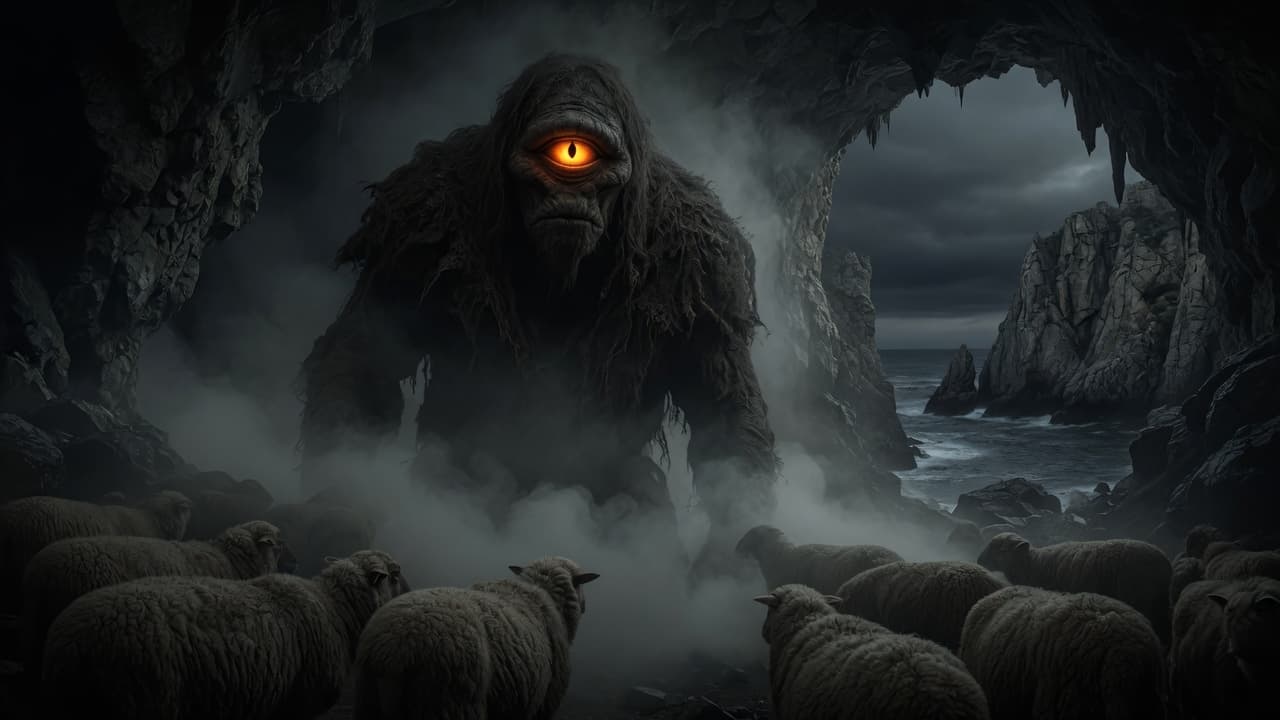
Polyphemus, son of Poseidon and the nymph Thoosa, keeps flocks on a wild island and knows no assembly, no law and no planted field: only the cave, the cheese-racks, the sheep, and his own hunger.
The story
Odysseus goes ashore with twelve men, expecting the exchange that governs the civilised world: a stranger arrives, is fed, and leaves with a gift. He finds a cave stacked with cheeses and lambs and decides to wait for the owner.
The owner arrives, rolls a stone across the entrance that no twenty wagons could shift, and asks who they are. Told about guest-right, he answers that the care nothing for Zeus, and eats two of the men. He eats two more in the morning. The trap is complete: kill him in his sleep and the survivors starve behind a door they cannot move.
So Odysseus gives his name as Nobody, gets the giant drunk on unmixed wine, and drives a sharpened olive stake into the single eye. Polyphemus roars for help and the other gather outside. Who is hurting you? Nobody. They leave. In the morning he opens the cave to let the sheep out to pasture and feels along their backs for escaping men, and the men leave underneath, roped beneath the bellies.
Then Odysseus makes his mistake. Safe offshore, he cannot resist shouting his real name. Polyphemus prays to his father, and Poseidon grants it, and ten years of sea follow.
A separate tradition gives him a wholly different life: in Theocritus and later in Ovid he is a lovesick herdsman singing badly to the sea-nymph Galatea, pitiable rather than terrifying. Both versions were current at once.
Where it comes from
Homer's Odyssey Book 9 is the source everything else answers to, and it was already old when it was written down: late eighth or seventh century BCE on many estimates, drawing on oral material of uncertain age.
The pastoral Polyphemus belongs to a later Hellenistic taste. Theocritus, writing in the third century BCE, makes him a comic lover in Idylls VI and XI; Ovid reworks the same triangle of Polyphemus, Galatea and Acis in Metamorphoses XIII, where the jealous giant crushes his rival with a boulder.
Euripides had meanwhile put the Homeric episode on stage as the satyr play , our only complete surviving example of the form.
Hesiod's are a different set entirely: Brontes, Steropes and Arges, smiths who forge Zeus's thunderbolt. The tradition has at least two unrelated groups of one-eyed beings under one name.
Motifs
The single eye
A giant with one eye, and the blinding or losing of it. The motif recurs on separate continents with no plausible line of transmission between them.
Also carried by: Balor (Celtic / Irish), Croatian Giants: The Lesser Traditions (Croatian), Katallani (Albanian), Mapinguari (Amazonian, Brazilian), Ojáncanu (Cantabrian), Papinijuwari (Australian Aboriginal (Tiwi)), Tepegöz (Oghuz Turkic), The Cailleach (Gaelic: Irish, Scottish, Manx), Ysbaddaden Bencawr (Welsh)
Eater of people
The giant as appetite: it takes travellers, children or the sick. Frequently a warning attached to a specific dangerous place.
Also carried by: Amazimu (Zulu / Nguni), Chinny-kinik (Australian Aboriginal), Cormoran (Celtic / Cornish), Dzunukwa (Kwakwaka'wakw / Northwest Coast), Giant of the Forest (Hausa / West African), Kee-Wakw (Abenaki / Wabanaki), Maero (Māori / Polynesian), Murkupang (Australian Aboriginal), Ojáncanu (Cantabrian), Oni (Japanese), Papinijuwari (Australian Aboriginal (Tiwi)), Shuten Dōji (Japanese), Si-Te-Cah (Paiute), Stallo (Sámi), Tepegöz (Oghuz Turkic), Thardid Jimbo (Australian Aboriginal)
Defeated by cunning
The giant loses to intelligence rather than strength: a trick, a false name, a riddle. Size is set up precisely so that it can fail.
Also carried by: Amazimu (Zulu / Nguni), Baqbaq-Devi (Georgian), British Giants: The Lesser Traditions (British and Welsh), Cormoran (Celtic / Cornish), Gogmagog (Celtic / British), Goliath of Gath (Biblical / Philistine), Humbaba (Sumerian, Akkadian, later Hurrian and Hittite), Rübezahl (German / Silesian / Czech), Shuten Dōji (Japanese), Skrymir (Norse), Stallo (Sámi), Tepegöz (Oghuz Turkic), Thrym (Norse), Waligóra and Wyrwidąb (Polish), Antaeus (Greek), Talos (Greek), The Gigantes (Greek)
What is disputed
The blinded-ogre story is not exclusive to Homer. Versions in which a trapped hero blinds a one-eyed cave-dweller and escapes among the flock have been recorded across Europe, the Caucasus and Central Asia, and folklorists catalogue them as a single international tale type.
Whether these descend from Homer, feed into him from older oral tradition, or represent independent tellings of the same situation has been argued for over a century without settlement. The escape-under-the-sheep detail appears in versions with no plausible route from Greek literature, which has been the main argument that Homer was working with existing material rather than inventing it. Because that escape is itself part of the standard type description (AaTh 1137), using its presence as proof is close to circular, and sceptics (among them O'Sullivan 1987 and Gousopoulos 2025) attack exactly that inference.
A sharper split runs between the blinding and the false name. Comparative study since Nyrop has treated them as separable. Hackman found Homer's form of the name trick in only one folk variant (from Anjou), and there in a tale without a . On that reading Homer's distinctive move is not the ruse under the sheep but the substitution of Nobody for Self, so the pun survives in the third person.
A long-standing suggestion that the was inspired by dwarf elephant skulls found in Sicilian caves, the central nasal opening read as an eye socket, is popular but has no ancient support and is not accepted by most scholars.
Sources
- Homer, Odyssey IX.105-566
- Euripides, Cyclops (satyr play, 5th c. BCE)
- Theocritus, Idylls VI and XI
- Ovid, Metamorphoses XIII.750-897 (Polyphemus, Galatea and Acis)
Part of
Scholarly notes
Sources and scholarly notes come with the same membership.
Chain of custody
The trick in Odyssey 9, where Odysseus gives his name as Nobody and then blinds the Cyclops and escapes under the sheep, was invented by Homer for the poem, and the folk versions collected later across Europe and Asia are descendants of it.
The surviving documents split the claim rather than settling it: the blinding and the escape under the flock are attested in traditions that scholars have long declined to derive from the poem, while the false name is argued about on separate grounds, and recent work warns against reconstructing what stood behind Homer at all.
Mark for My Journey
Private marks. They are not a collection score.
Marks stay on this device for this session. Sign in to keep your marks.
Frequently asked
- Who was Polyphemus?
- In Homer’s Odyssey Book 9, Polyphemus is son of Poseidon and the nymph Thoosa, a Cyclops who keeps flocks on a wild island. Odysseus finds the cave; Polyphemus traps the men, eats some of them, and is blinded with a sharpened olive stake. A separate tradition in Theocritus and Ovid makes him a lovesick herdsman singing to the sea-nymph Galatea. Both versions were current at once.
- Was Polyphemus a giant?
- The Odyssey presents him as a Cyclops large enough that the stone across his cave-mouth is one no twenty wagons could shift. Hesiod’s Cyclopes, Brontes, Steropes and Arges, smiths who forge Zeus’s thunderbolt, are a different set entirely. The tradition has at least two unrelated groups of one-eyed beings under one name.
- How did Odysseus escape Polyphemus?
- Odysseus gives his name as Nobody, gets Polyphemus drunk on unmixed wine, and drives a sharpened olive stake into the single eye. When the other Cyclopes ask who is hurting him, he answers Nobody, and they leave. In the morning the men leave underneath the sheep. Safe offshore, Odysseus shouts his real name; Polyphemus prays to Poseidon.
- Did Homer invent the blinded Cyclops story?
- The blinded-ogre story is not exclusive to Homer. Folklorists catalogue versions across Europe, the Caucasus and Central Asia as tale type AaTh 1137. Whether these descend from Homer, feed into him, or represent independent tellings has been argued for over a century without settlement. Comparative study since Nyrop has treated the blinding and the false name as separable.
- Were Cyclopes inspired by elephant skulls?
- A long-standing suggestion that the Cyclops was inspired by dwarf elephant skulls found in Sicilian caves, the central nasal opening read as an eye socket, is popular but has no ancient support and is not accepted by most scholars.
Related giants
 BalorCeltic / Irish · Fomorian king whose eye destroyed armies: slain by his grandson Lugh.
 OrionGreek · The hunter so great he was set among the stars.
 AntaeusGreek · Libyan giant who drew strength from the earth: until Heracles lifted him.
 GeryonGreek · Three-bodied giant of the far west whose cattle Heracles stole.
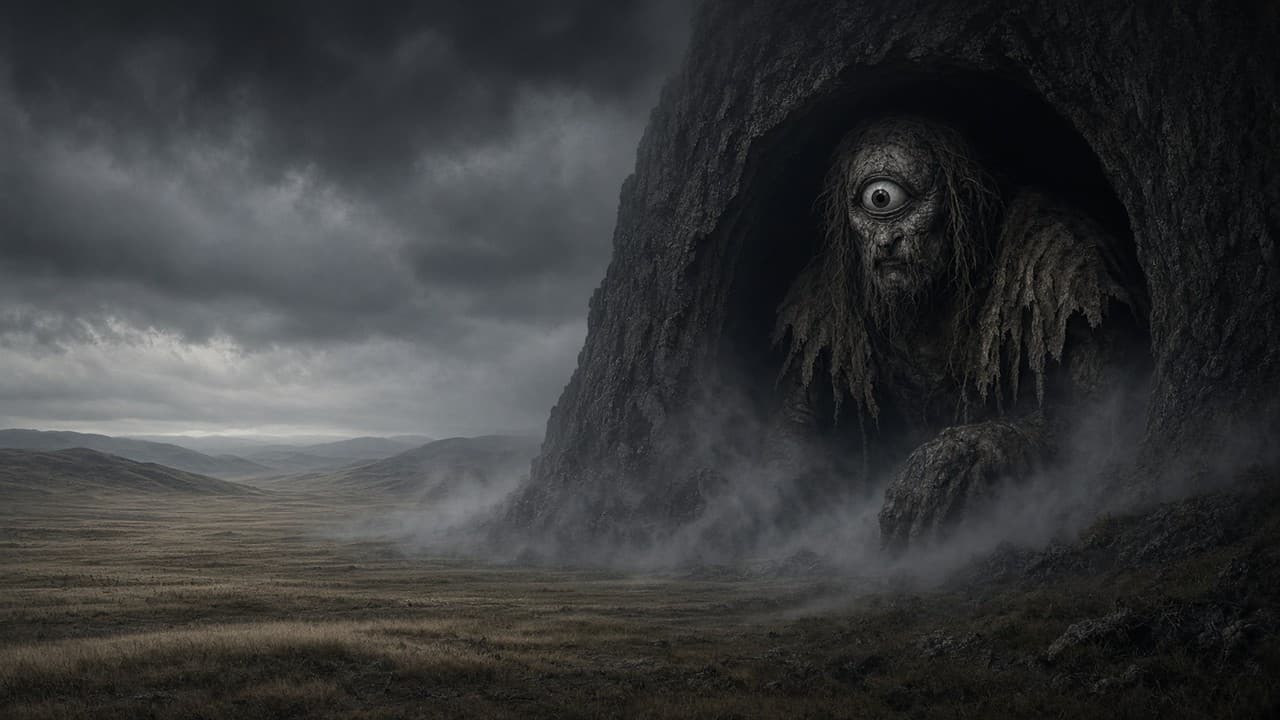 TepegözOghuz Turkic · A one-eyed man-eater, blinded in his cave by a young man who tricked him. When a...