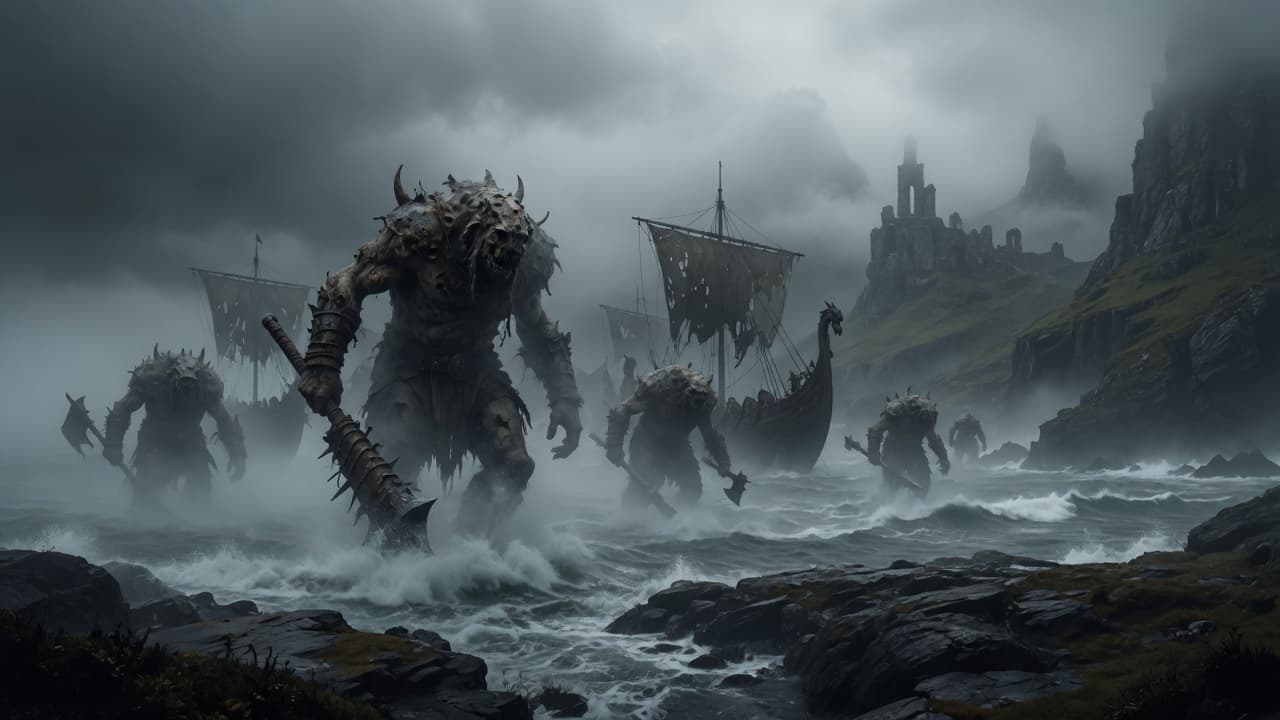
Fomorians
Also known as: Fomoire, Fomhóraigh, Fomori
Basic account
Irish adversary race out of the sea: their rule banned the teaching of poetry and law.
Account
They banned the teaching of poetry and law. That is what the sources remember about their rule, before anything about their size.
The story
The Fomorians are the adversary race of Irish tradition. In the oldest layer they come from under the sea or under the earth. Later they are recast as sea raiders and giants, and later still as pirates from somewhere else entirely.
For a period they ruled. They took tribute from the Tuatha Dé Danann and from the Nemedians before them, and they forbade the scholars, the bards and the druids to teach. A giant race that suppresses education is a more interesting occupier than one that simply smashes things.
Their fall is a family matter. Balor, their commander, gave his daughter Ethne to Cían of the Tuatha Dé Danann. The child of that marriage was Lugh, who led the overthrow of Fomorian rule and killed Balor himself. The great enemy is destroyed by his own grandson.
Where it comes from
Cath Maige Tuired, the Second Battle of Mag Tuired, carries the fullest account: a Middle Irish narrative resting on earlier material, surviving in London, British Library, Harleian MS 5280, written by Giolla Riabhach Ó Cléirigh in the early sixteenth century. Whitley Stokes edited it in 1891, Elizabeth A. Gray for the Irish Texts Society in 1982.
Lebor Gabála Érenn supplies the other frame, setting the Fomorians against each people that reaches Ireland. It exists in several recensions rather than as one text, compiled from the eleventh century onward and edited by R. A. S. Macalister for the Irish Texts Society between 1932 and 1942.
Lebor na hUidre, written at Clonmacnoise around 1100, once held a copy of Lebor Gabála. Those leaves are now lost.
Mícheál Ó Cléirigh made his own recension in 1631 and led the Annals of the Four Masters at Bundrowes, County Donegal, from 1632 to 1636. Geoffrey Keating completed Foras Feasa ar Éirinn around 1634; it circulated in manuscript, unprinted until 1723.
Motifs
The people who came before
Giants as an earlier race displaced by the present one. Often a way of accounting for ruins, large bones, or an older population.
Also carried by: Bestla (Norse), British Giants: The Lesser Traditions (British and Welsh), Croatian Giants: The Lesser Traditions (Croatian), Fangfeng (Chinese), Gogmagog (Celtic / British), Ispolini (Bulgarian), Jentilak (Basque), Kahui-Tipua (Māori), Kalev and Kalevipoeg (Estonian, Finnish, Karelian), Katallani (Albanian), Koljo (Finnish), Milžinai (Lithuanian), Mouros (Galician, Asturian, Portuguese), Nawao (Māori), Nemri (Croatian), Nephilim (Biblical / Near Eastern), Og of Bashan (Biblical / Near Eastern), Quinametzin (Mesoamerican / Aztec), Si-Te-Cah (Paiute), Surid ibn Salhouk (Coptic and Islamic Egypt, medieval), The Giants of Santa Elena (Manta, recorded by Spanish chroniclers), The Giants of the Canaries (European accounts of the Guanches), The Gigantes (Greek), The Patagonian Giants (European accounts of the Tehuelche and Selk'nam), Tombe dei Giganti (Sardinian), Uriași (Romanian), Ymir (Norse), ʿĀd, Iram and Thamud (Arabian and Islamic), ʿUj ibn ʿAnāq (Islamic tradition, Arabic and Persian)
Arrived by sea
The giants come from the water, on rafts, in reed boats, or simply out of it. The sea supplies an origin that needs no genealogy.
Also carried by: The Giants of Santa Elena (Manta, recorded by Spanish chroniclers)
What is disputed
The *Lebor Gabála Érenn* is a pseudo-history. It was compiled by Christian scribes in the eleventh century to give Ireland an origin story comparable to the biblical one, folding surviving oral material into a scheme running from the Flood forward.
It is a real and valuable source and it is not a neutral record of pagan tradition. Where it disagrees with itself about who the Fomorians were and when they arrived, that is the seam showing.
Sources
- Lebor Gabála Érenn, 11th century
- Cath Maige Tuired
- Lebor na hUidre, 11th century
- Annals of the Four Masters
- Geoffrey Keating
Scholarly notes
Sources and scholarly notes come with the same membership.
Mark for My Journey
Private marks. They are not a collection score.
Marks stay on this device for this session. Sign in to keep your marks.
Frequently asked
- Who were the Fomorians in Irish mythology?
- They are the adversary race of Irish tradition. In the oldest layer they come from under the sea or under the earth. Later they are recast as sea raiders and giants, and later still as pirates from somewhere else entirely. For a period they ruled, taking tribute from the Tuatha Dé Danann and from the Nemedians before them. Cath Maige Tuired carries the fullest account; Lebor Gabála Érenn supplies the other frame.
- Were the Fomorians giants?
- Giant stature is a later recasting: first under sea or earth, later sea raiders and giants, later still pirates from somewhere else. What the sources remember about their rule, before anything about their size, is that they banned the teaching of poetry and law. Height in the catalogue is unmeasured.
- What did the Fomorians forbid?
- They forbade the scholars, the bards and the druids to teach. That is what the sources remember about their rule, before anything about their size. What was in the teaching that made it worth forbidding is not recorded.
- How did Fomorian rule end?
- Their fall is a family matter. Balor, their commander, gave his daughter Ethne to Cían of the Tuatha Dé Danann. The child of that marriage was Lugh, who led the overthrow of Fomorian rule and killed Balor himself.
- Are the medieval Irish texts a pagan record?
- Lebor Gabála Érenn is a pseudo-history, compiled by Christian scribes in the eleventh century to give Ireland an origin story comparable to the biblical one. It is a real and valuable source and it is not a neutral record of pagan tradition. Where it disagrees with itself about who the Fomorians were and when they arrived, that is the seam showing.
Related giants
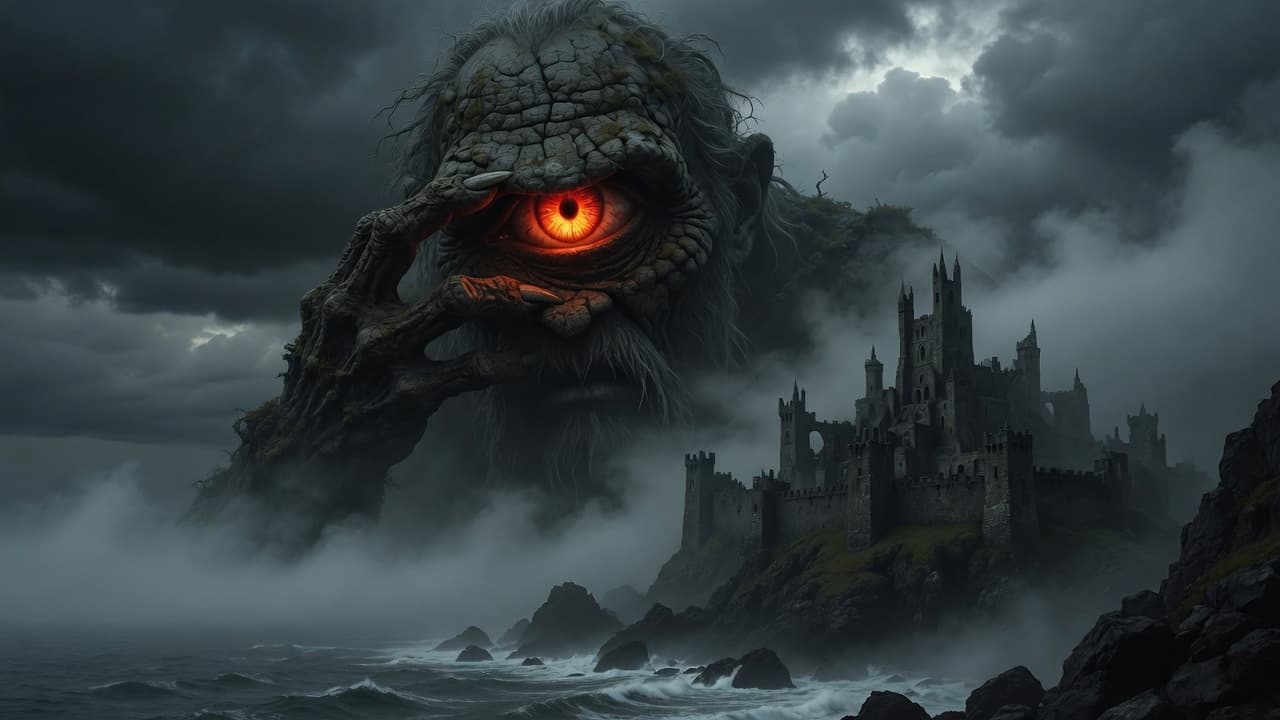 BalorCeltic / Irish · Fomorian king whose eye destroyed armies: slain by his grandson Lugh.
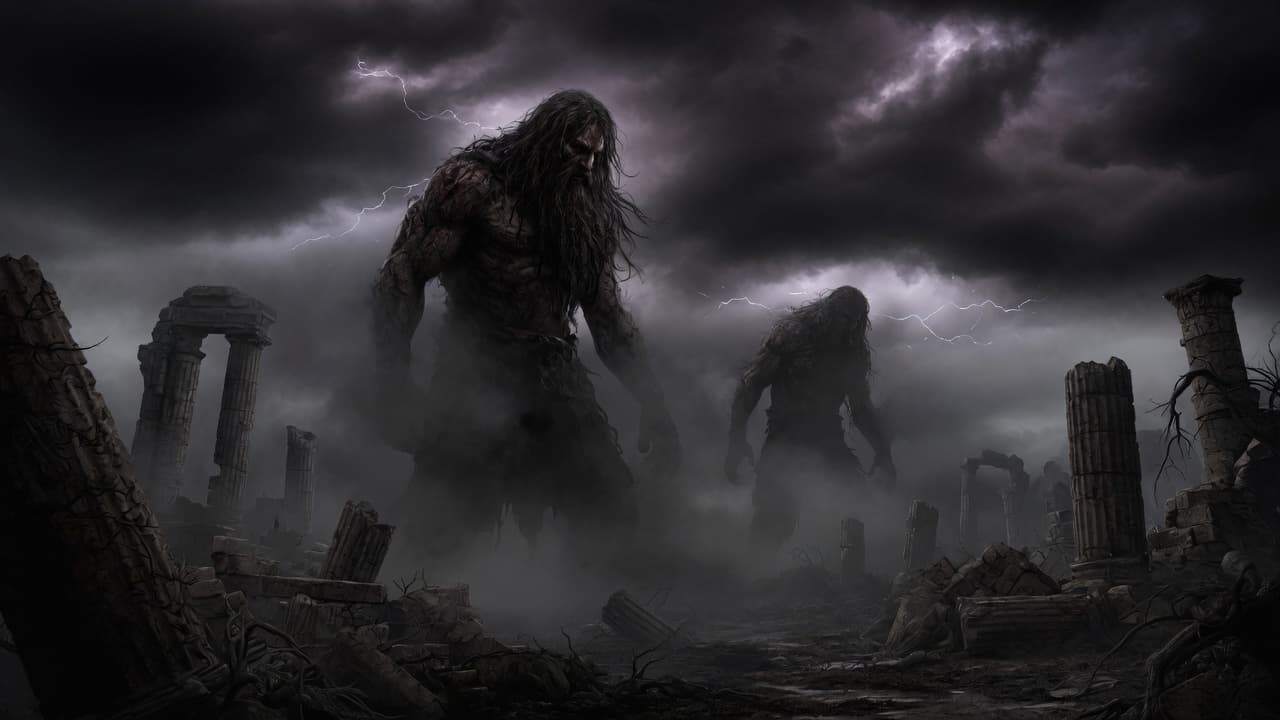 NephilimBiblical / Near Eastern · The mighty ones of old: offspring of the sons of God and daughters of men.
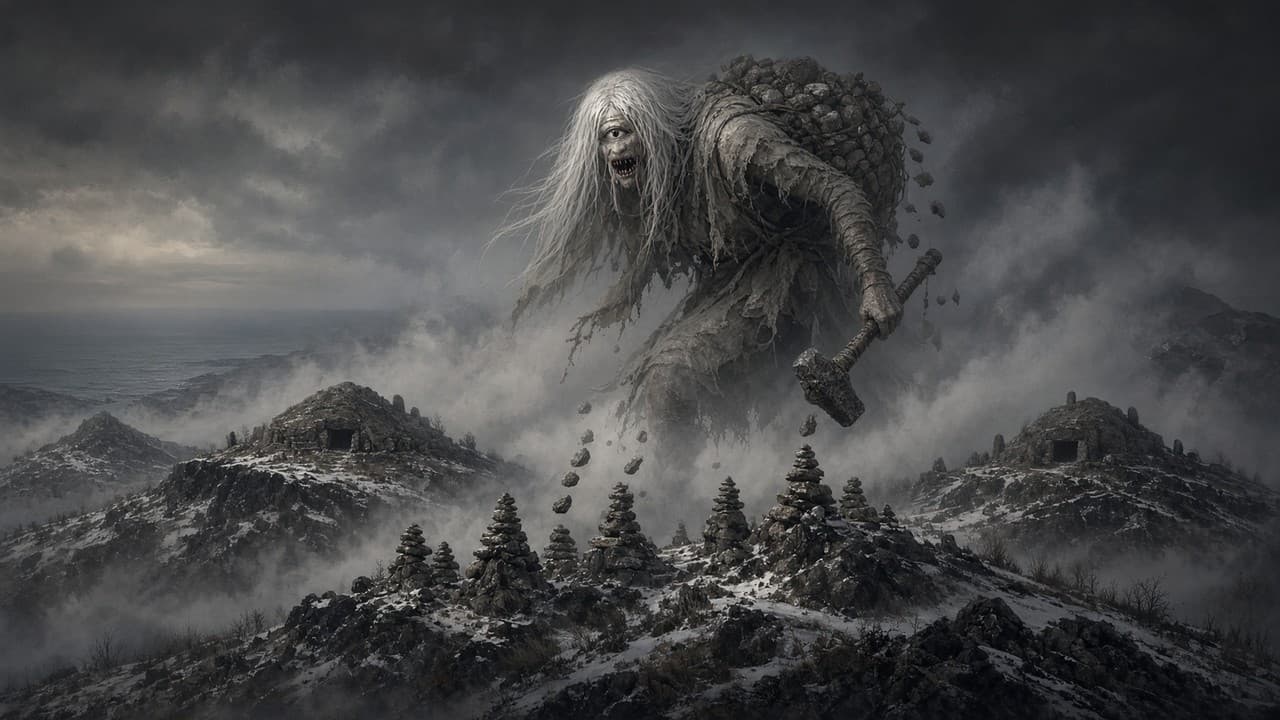 The CailleachGaelic: Irish, Scottish, Manx · The Neolithic passage tombs at Loughcrew are said to be stones that fell out of ...