AI illustration
ʿUj ibn ʿAnāq
Also known as: Uj ibn Anaq, Ogias
Basic account
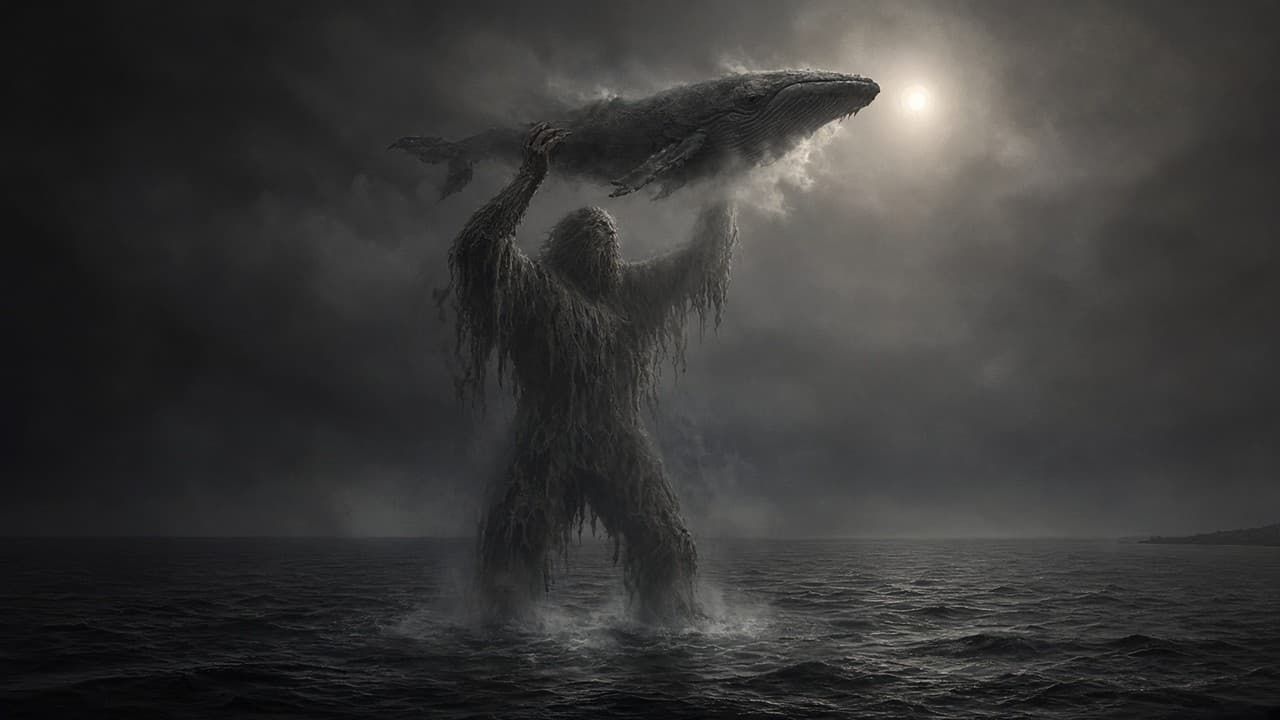
He is the biblical Og, after five centuries of retelling. By the end he was standing knee-deep in the open ocean, catching whales and holding them up to the sun to cook.
Account
Uj ibn Anaq is not in the Qur'an and not in the canonical hadith. He comes into Arabic literature out of Jewish folklore and the Hebrew Bible, where he is Og, the Amorite king of Bashan whom Moses defeats at Edrei.
This catalogue already holds him under that name.
The story
He takes his name from his mother, Anaq, held in the tradition to be a daughter of Adam, and the circumstances of his birth are given as incestuous, which marks him as wrong from the outset rather than merely large.
What happened to him afterwards is the point of the entry. In the Hebrew text Og is a king with sixty walled cities who loses a battle. In the Arabic and Persian tradition he grows without limit. He fights Moses directly. He wades into the deep ocean, which reaches only to his knees, catches whales in his hands, and lifts them up toward the sun to fry them.
Both of these became standard subjects for painters, and he is one of the most illustrated giants in Islamic manuscript art.
This makes Uj the clearest case in the catalogue of a giant who grew in transmission. The catalogue holds him at two points on the same line: as Og, a defeated regional king, and as Uj, a being for whom the sea is shallow.
Where it comes from
Numbers 21 and Deuteronomy 3 are the Hebrew account of Og of Bashan, already in this catalogue. Uj ibn Anaq is not in the Qur'an and not in the canonical hadith.
He enters Arabic and Persian folkloric and exegetical literature from that biblical and Jewish folkloric line. The apocryphal Book of Giants, from around the second century BCE and surviving among the Dead Sea Scrolls, follows a giant named Ogias who fights a great dragon.
Islamic manuscript painting made the whale and the knee-deep ocean into standard subjects. Read this entry next to Og of Bashan, not instead of him.
Motifs
Grown in the telling
A figure or people who start at human scale in the early record and become giants later, in retelling, painting or popular reading. The growth is the evidence.
Also carried by: Surid ibn Salhouk (Coptic and Islamic Egypt, medieval), The Giants of the Canaries (European accounts of the Guanches), ʿĀd, Iram and Thamud (Arabian and Islamic)
The people who came before
Giants as an earlier race displaced by the present one. Often a way of accounting for ruins, large bones, or an older population.
Also carried by: Bestla (Norse), British Giants: The Lesser Traditions (British and Welsh), Croatian Giants: The Lesser Traditions (Croatian), Fangfeng (Chinese), Fomorians (Irish), Gogmagog (Celtic / British), Ispolini (Bulgarian), Jentilak (Basque), Kahui-Tipua (Māori), Kalev and Kalevipoeg (Estonian, Finnish, Karelian), Katallani (Albanian), Koljo (Finnish), Milžinai (Lithuanian), Mouros (Galician, Asturian, Portuguese), Nawao (Māori), Nemri (Croatian), Nephilim (Biblical / Near Eastern), Og of Bashan (Biblical / Near Eastern), Quinametzin (Mesoamerican / Aztec), Si-Te-Cah (Paiute), Surid ibn Salhouk (Coptic and Islamic Egypt, medieval), The Giants of Santa Elena (Manta, recorded by Spanish chroniclers), The Giants of the Canaries (European accounts of the Guanches), The Gigantes (Greek), The Patagonian Giants (European accounts of the Tehuelche and Selk'nam), Tombe dei Giganti (Sardinian), Uriași (Romanian), Ymir (Norse), ʿĀd, Iram and Thamud (Arabian and Islamic)
What is disputed
Where he came from before the Bible. The apocryphal Book of Giants, from around the second century BCE and surviving among the Dead Sea Scrolls, follows a giant named Ogias who fights a great dragon, and Ogias has been identified either with Og himself or with Og's father.
That text belongs to the Enochic literature, which means it sits directly alongside this catalogue's existing Nephilim material.
The growth itself is not in dispute. In the Hebrew text Og is a king with sixty walled cities who loses a battle. In the Arabic and Persian tradition he wades an ocean that reaches his knees. Those are two stages of one name, not two independent giants.
Sources
- Numbers 21 and Deuteronomy 3
- Arabic and Persian folkloric and exegetical literature
- the Book of Giants, c. 2nd century BCE, Dead Sea Scrolls
- Islamic manuscript painting
Session Prep
Source shelf
- Numbers 21 and Deuteronomy 3
- Arabic and Persian folkloric and exegetical literature
- the Book of Giants, c. 2nd century BCE, Dead Sea Scrolls
- Islamic manuscript painting
Part of
Mark for My Journey
Private marks. They are not a collection score.
Marks stay on this device for this session. Sign in to keep your marks.
Related giants
 Og of BashanBiblical / Near Eastern · Last of the Rephaim; king of Bashan whose iron bed was a wonder.
 Goliath of GathBiblical / Philistine · The Philistine champion of Gath who fell to a shepherd's stone.
 NephilimBiblical / Near Eastern · The mighty ones of old: offspring of the sons of God and daughters of men.
 ʿĀd, Iram and ThamudArabian and Islamic · The peoples the Qur'an says were destroyed for arrogance. It does not say they w...