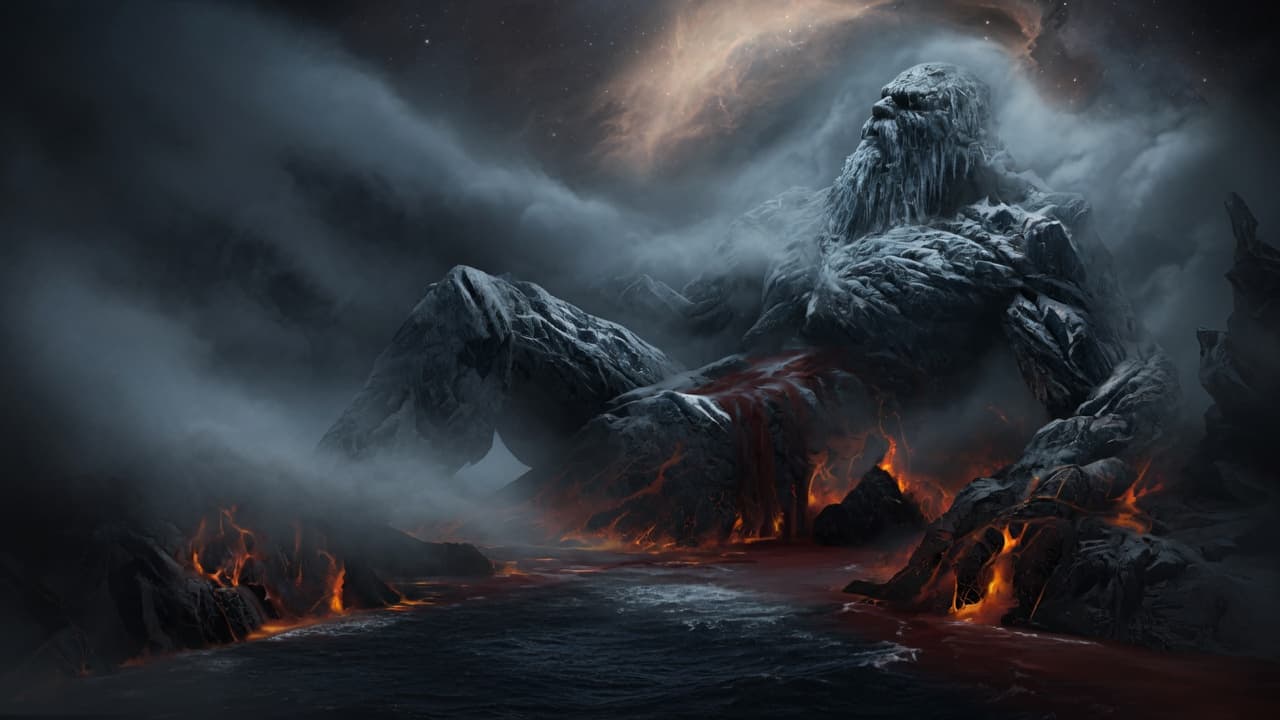
Ymir
Also known as: Aurgelmir, Brimir, Bláinn
Basic account
The first being. From his corpse the world was made.
Account
In the yawning void called Ginnungagap, where the heat of Muspellheim met the killing ice of Niflheim, the first life stirred. From melting rime rose Ymir (also named Aurgelmir; the name's two members remain open between clay, gravel, barley or sheaf and roarer or similar, not a settled "clay-roarer") neither fully god nor fully giant, but the wet, roaring beginning of both.
The story
The Norse cosmos does not begin with a maker. It begins with a gap.
Ginnungagap lay between Muspellheim's fire and the killing ice of Niflheim, and where the two met the rime began to drip. From that meltwater rose Ymir, called Aurgelmir in the older poems, neither god nor giant but the wet, roaring precondition of both. The primeval cow Auðumbla licked the salt-rime for nourishment and fed him; from his sweat, under his arm, a man and a woman took shape, and from his legs a six-headed son. The line was established before the gods had names.
He was killed by his own descendants. Odin, Vili and Vé (sons of Borr and the giantess Bestla, and so Ymir's own kin) struck him down. His blood came out as a flood, and it drowned very nearly all the frost-giants. Only Bergelmir escaped with his household, aboard something the sources will not agree on: a hollowed log, a chest, a mill-frame. Every later giant in the North descends from that one survivor.
Then the brothers built the world from the corpse. Flesh became earth; bone became mountain; teeth and jaw-shards became scree and stone. The blood was poured out as sea and lake. The skull was raised as the sky's vault and set on four dwarfs at the corners, named for the compass. The brains were thrown up as cloud. The maggots that had bred in the dead flesh were given wit and shape, and became the dwarfs.
This is not decoration. It is a cosmology in which the ground is a body, and every ridge you walk is a piece of someone the gods murdered.
Where it comes from
The account survives in two thirteenth-century Icelandic compilations of much older material.
Snorri Sturluson's Prose Edda gives the fullest narrative version in Gylfaginning, where the world's construction from the body is laid out piece by piece. Snorri was a Christian writing around 1220, some two centuries after Iceland's conversion, and he is systematising traditions that reached him already fragmented: a point worth holding onto, because his tidiness is partly his own.
The Poetic Edda preserves the older, stranger layer. Vafþrúðnismál has Odin and the giant Vafþrúðnir trade cosmological riddles, and it is there that Ymir's other name, Aurgelmir, and the detail of Bergelmir's escape appear. Grímnismál gives the body-to-world correspondences in compressed verse form. These poems are undated and probably circulated orally for a long time before anyone wrote them down.
The two sources do not fully agree, and Snorri appears at points to be reading the poems much as we do: as an inheritor working out what they meant.
Motifs
A world built from a body
The earth, sky and sea are made from the dismembered corpse of a primordial giant. Mountains are bones; rivers are blood.
Survivor of the flood
A giant or giant-descended line survives a deluge that destroys the rest of its kind, and so carries the old world into the new one.
Also carried by: Nephilim (Biblical / Near Eastern), Xelhua (Mesoamerican)
The people who came before
Giants as an earlier race displaced by the present one. Often a way of accounting for ruins, large bones, or an older population.
Also carried by: British Giants: The Lesser Traditions (British and Welsh), Croatian Giants: The Lesser Traditions (Croatian), Fangfeng (Chinese), Fomorians (Irish), Gogmagog (Celtic / British), Ispolini (Bulgarian), Jentilak (Basque), Kahui-Tipua (Māori), Kalev and Kalevipoeg (Estonian, Finnish, Karelian), Katallani (Albanian), Koljo (Finnish), Milžinai (Lithuanian), Mouros (Galician, Asturian, Portuguese), Nawao (Māori), Nemri (Croatian), Nephilim (Biblical / Near Eastern), Og of Bashan (Biblical / Near Eastern), Quinametzin (Mesoamerican / Aztec), Si-Te-Cah (Paiute), Surid ibn Salhouk (Coptic and Islamic Egypt, medieval), The Giants of Santa Elena (Manta, recorded by Spanish chroniclers), The Giants of the Canaries (European accounts of the Guanches), The Gigantes (Greek), The Patagonian Giants (European accounts of the Tehuelche and Selk'nam), Tombe dei Giganti (Sardinian), Uriași (Romanian), ʿĀd, Iram and Thamud (Arabian and Islamic), ʿUj ibn ʿAnāq (Islamic tradition, Arabic and Persian), Bestla (Norse)
The first and the last
A primordial pair bound to opposite poles of the same cosmology: one marks the world's beginning, the other its end, and each is best read next to the other.
Also carried by: Surtr (Norse)
What is disputed
What Bergelmir escaped in is genuinely unresolved. The Old Norse phrase á lúðr has been read as a chest, a hollowed trunk, a boat, a cradle and a mill-box; each reading pulls the episode in a different direction, and the flood-and-ark resemblance that some scholars have drawn to Near Eastern material depends heavily on which one you pick.
Whether that resemblance means anything at all is contested. It may be inherited, it may be borrowed, it may be Snorri's Christian formation showing through, or the pattern may simply be one that many flood traditions arrive at independently.
The relationship between Ymir and Aurgelmir is also not settled: one being under two names, or two beings that merged before the poems were fixed.
Sources
- Snorri Sturluson, Prose Edda: Gylfaginning (Iceland, c. 1220)
- Poetic Edda: Vafþrúðnismál, stanzas 21 and 28-35
- Poetic Edda: Grímnismál, stanzas 40-41
Part of
Scholarly notes
Sources and scholarly notes come with the same membership.
Chain of custody
Ymir's name means "Scream": the primordial scream in the void, so that the giant out of whose body the Norse world was built is named for the sound of the beginning.
The Old Norse texts that name Ymir give the name and one alternative name for him and do not say what either means; the reading "Scream" is a modern argument about what a medieval audience would have heard in the word, published in 2003 and picked up from there.
Mark for My Journey
Private marks. They are not a collection score.
Marks stay on this device for this session. Sign in to keep your marks.
Frequently asked
- Who was Ymir?
- In the Poetic Edda and in Snorri Sturluson’s Prose Edda, Ymir is the first being who rose from melting rime in Ginnungagap, where Muspellheim’s heat met Niflheim’s ice. He is called Aurgelmir in the older poems. The primeval cow Auðumbla fed him; from his sweat a man and a woman took shape, and from his legs a six-headed son.
- Was Ymir a giant?
- The account will not settle it as a simple yes: neither fully god nor fully giant, but the wet, roaring beginning of both. The jötunn line is established from him before the gods had names. He is killed by his own descendants: Odin, Vili and Vé, sons of Borr and the giantess Bestla.
- How was the world made from Ymir’s body?
- After Odin, Vili and Vé struck him down they built the world from the corpse. Snorri’s Gylfaginning lays it out piece by piece; Grímnismál gives the correspondences in compressed verse. Flesh became earth; bone became mountain; teeth and jaw-shards became scree and stone; blood was poured as sea and lake; the skull was raised as the sky’s vault; the brains were thrown up as cloud.
- Is Ymir the same as Aurgelmir?
- The poems use both names. Vafþrúðnismál is where Ymir’s other name, Aurgelmir, and Bergelmir’s escape appear. What is disputed is unsettled: one being under two names, or two beings that merged before the poems were fixed.
- What did Bergelmir escape in?
- Ymir’s blood came out as a flood that drowned very nearly all the frost-giants; only Bergelmir escaped with his household. The Old Norse phrase á lúðr has been read as a chest, a hollowed trunk, a boat, a cradle and a mill-box. Each reading pulls the episode in a different direction, and the sources will not agree.
Related giants
 SurtrNorse · The fire giant who guarded the world's edge before it existed, and will burn it ...
 ThrymNorse · Frost giant who stole Mjölnir and demanded Freyja as bride.
 HrungnirNorse · Stone-hearted giant who dueled Thor and left a whetstone in his head.
 SkrymirNorse · The vast wanderer whose glove was a hall: master of illusions.
 BestlaNorse · Frost-giantess mother of Odin: the gods' giant bloodline.
 PanguChinese · He was not killed. He held the sky up for eighteen thousand years until it staye...