Talos
Also known as: Talus
Basic account
The bronze guardian of Crete: automaton giant with a single vein of ichor.
Account
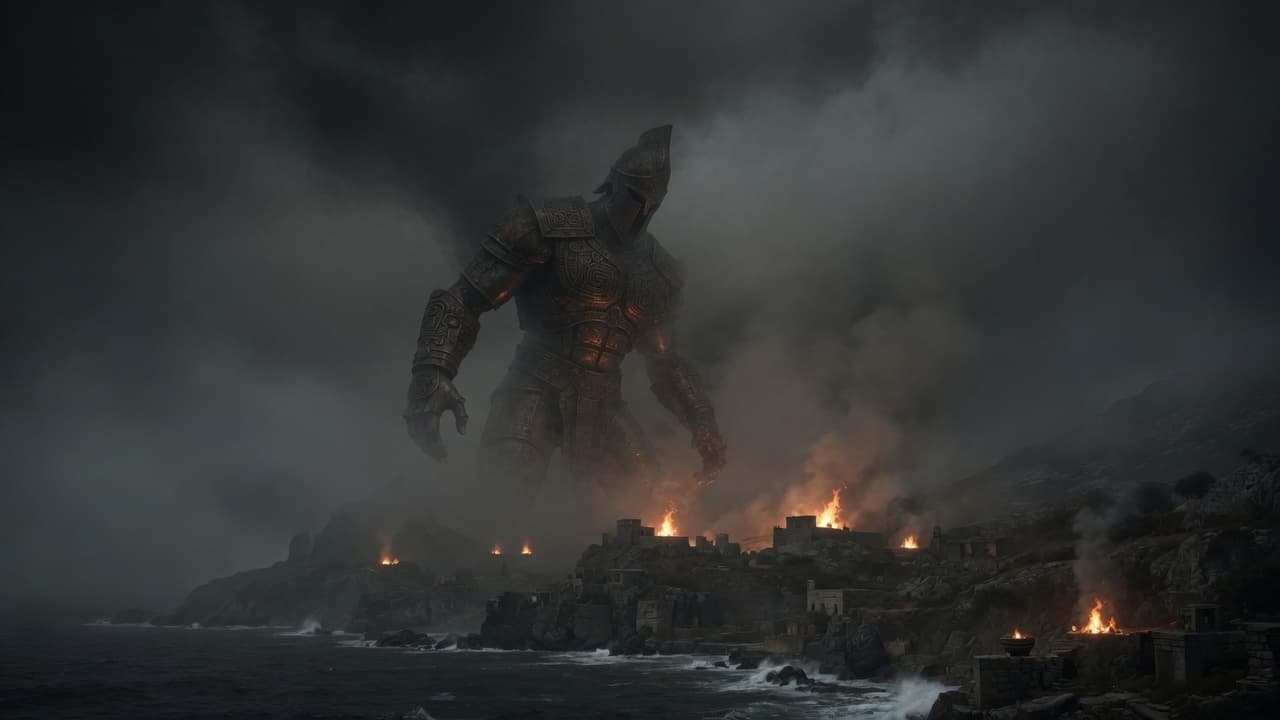
Talos is a giant of bronze who walks the coast of Crete three times a day and throws rocks at approaching ships. He was not born.
He was made, and he has one vein, closed by a single bronze nail at his ankle.
The story
Crete had a border guard, and it was a machine.
Talos circles the island three times daily on foot, watching for ships. Vessels that come too close are driven off with boulders. Those that land are dealt with directly: he heats his bronze body in fire and embraces intruders until they burn. He is a defensive system with a patrol route.
His construction is variously credited to Hephaestus or to Daedalus, and his internal design is unusually specific for a mythological being. A single vessel runs from his neck to his ankle, carrying not blood but ichor, the fluid of the gods, and it is sealed at the ankle by a bronze nail or plug.
The Argonauts arrive on the way home with the fleece. Medea deals with him, and how she does it varies: she bewitches him with the evil eye and drives him mad so that he grazes his ankle on a rock; or she promises to make him immortal and persuades him to let her draw the nail. Either way the seal fails, the ichor runs out like molten metal, and the giant empties and collapses.
He is killed by a leak. For a figure roughly three thousand years old, that is a remarkably modern way to die, and it is why Talos keeps being claimed as the first robot in Western literature: a claim worth some caution, but not an unreasonable one.
Where it comes from
Apollonius of Rhodes, Argonautica IV.1638-1688, third century BCE, gives the fullest surviving account: the patrol, the single vein, the nail, and Medea's undoing of him.
Apollodorus, Bibliotheca I.9.26, records the competing versions of his manufacture and death.
He appears in art earlier than these texts. A well-known Attic red-figure krater of the fourth century BCE shows him collapsing into the arms of the Dioscuri, and Cretan coins from Phaistos depict him as a winged figure throwing stones.
The dialogue Minos, transmitted under Plato's name and widely thought not to be his, refers at 320c to a bronze man who patrolled Crete's villages carrying the laws inscribed on bronze tablets: a rationalised version in which the giant is a circuit judge. In that account the circuit is three times a year, not daily as in Apollonius.
Motifs
Made, not born
A giant forged rather than fathered, from bronze, clay or craft. It raises the question of whether the thing is alive at all.
The giant as guardian
Set to watch a place, an island or a people. Menace pointed outward instead of inward.
Also carried by: Dzunukwa (Kwakwaka'wakw / Northwest Coast), Gaoh (Iroquois / Haudenosaunee), Humbaba (Sumerian, Akkadian, later Hurrian and Hittite), Rübezahl (German / Silesian / Czech), Surtr (Norse), Tsul 'Kalu (Cherokee), Briareus (Greek), Geryon (Greek)
The body nothing pierces
Skin, scale or bark that no weapon can cut, and usually a single place where it can. The invulnerability exists to make the exception matter.
Also carried by: Mapinguari (Amazonian, Brazilian)
Defeated by cunning
The giant loses to intelligence rather than strength: a trick, a false name, a riddle. Size is set up precisely so that it can fail.
Also carried by: Amazimu (Zulu / Nguni), Baqbaq-Devi (Georgian), British Giants: The Lesser Traditions (British and Welsh), Cormoran (Celtic / Cornish), Gogmagog (Celtic / British), Goliath of Gath (Biblical / Philistine), Humbaba (Sumerian, Akkadian, later Hurrian and Hittite), Rübezahl (German / Silesian / Czech), Shuten Dōji (Japanese), Skrymir (Norse), Stallo (Sámi), Tepegöz (Oghuz Turkic), Thrym (Norse), Waligóra and Wyrwidąb (Polish), Antaeus (Greek), Polyphemus (Greek), The Gigantes (Greek)
What is disputed
What Talos originally was is unsettled. Proposals include a personification of the sun, a memory of Bronze Age metallurgy, and a folk explanation of Cretan coastal defence or of bronze statuary. None commands agreement.
The Minos's law-carrying version and Apollonius's automaton are difficult to relate, and the difference in patrol frequency is part of why. The account under Plato's name may be a philosopher's rationalisation, or it may preserve a genuinely different Cretan tradition in which Talos was an administrative rather than a monstrous figure. Attributing the dialogue flatly to Plato takes a side most modern classicists do not.
The frequent modern description of Talos as the first robot is defensible in that he is manufactured, autonomous and task-bound, but it imports a category the Greeks did not have. Ichor and divine craft place him closer to a living being made by a god than to a mechanism.
Sources
- Apollonius of Rhodes, Argonautica IV.1638-1688
- Apollodorus, Bibliotheca I.9.26
- Attic red-figure krater, 4th c. BCE (the death of Talos)
- Minos 320c (transmitted under Plato's name; authorship disputed): the rationalised, law-carrying Talos
Part of
Scholarly notes
Sources and scholarly notes come with the same membership.
Mark for My Journey
Private marks. They are not a collection score.
Marks stay on this device for this session. Sign in to keep your marks.